Website for an NGO or Charitable Foundation: What It Must Have




A donor, grantmaker, journalist, or person in need of help visits an organization's website with a single question: can you be trusted? A Facebook page doesn’t answer it: the charter, reports, and bank details get lost in the feed. According to Zagoriy Foundation, nearly half of Ukrainians link their trust in charity directly to transparency, reporting, and open communication. A website is the place where you are vetted.
When a single link-in-bio page is enough, and when you need a full website
You don't always need a website. When we joined a campaign to raise funds for a child's medical treatment, website development was delayed, so within an hour and for fifteen dollars we built a Taplink page — we discussed this in our breakdown of fundraising mechanics. For a short campaign with a tight deadline, this is sufficient.
It’s a different story for the public movement "Dity My Vstyhnemo" (We Will Make It In Time, Children), which lobbied for state-level solutions for SMA. For them, we created a comprehensive website: children's stories, news, support options, and project outcomes. The rule is simple: if the organization is meant to outlive a single campaign, it needs a website.
Must-have features for an NGO website
Projects instead of an abstract mission statement. On the Tandit Foundation website, each of the three key focus areas has a dedicated page with "Who We Help" and "How We Help" sections. Donors can see where their money is going even before clicking the donate button.
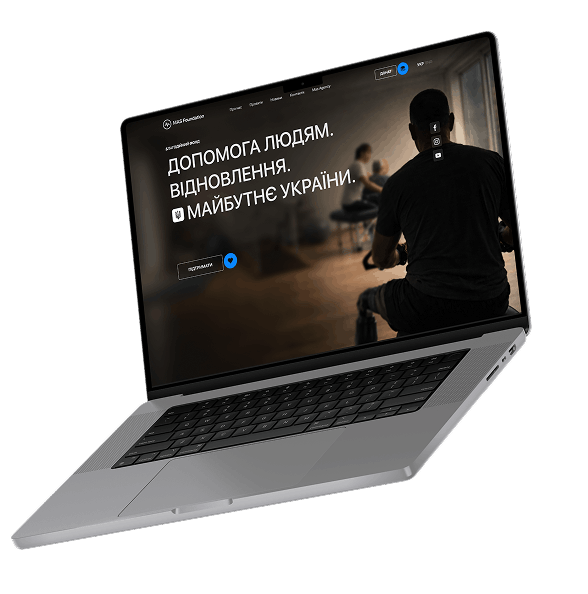
A team section with names and roles. In 2024, our team established our own fund, Mas Foundation, giving us a dual perspective on such websites — as a contractor and as a foundation. On its website, everyone is listed by name, from executive and financial directors to project coordinators: the question "who is behind this" should never remain unanswered.
An entryway for those seeking assistance. In social sector projects, we map out two core user journeys right at the wireframing stage: how a user supports the organization and how they apply for help. Read more about NGO target audiences in our article on NGO communications.
An English version, if your donor base includes international partners. For Tandit Foundation, we tailored search engine optimization specifically to attract international sponsors.
Trust: documents, reporting, and partners
The Tandit Foundation website features a dedicated "Reporting" section containing its charter, registry excerpt, non-profit status confirmation, and the 2025 annual report. Built on WordPress, the site allows the foundation team to upload reports and post news independently without waiting on developers.
The law is on your side. Article 17 of the Law of Ukraine "On Charitable Activities and Charitable Organizations" explicitly states that information regarding a charitable organization's income and expenses is not confidential. However, personal details of donors and beneficiaries can only be published with their consent — this also applies to photos.
Partner logos linked to their websites and a media coverage gallery act as external proof of credibility. We analyzed how to secure them without a budget separately.
The donation button, Ukrainian-style
Stripe, which is commonly recommended by Western guidelines, is unavailable to legal entities registered in Ukraine. On the Tandit Foundation and Mas Foundation websites, the primary donation method consists of direct bank transfer details in a modal window, with quick-copy buttons next to each field on Tandit. As the foundation explains, all contributions go straight to the corporate account and are fully reflected in statements.
Next, adapt to the device. According to M+R Benchmarks 2026, smartphones account for 52% of visits to non-profit websites, but 72% of total revenue originates from desktop devices. In smaller organizations, only 4% of mobile visitors who reach the donation page complete a transaction. Copy buttons save the day on mobile. On desktop, NBU-standard QR codes work best: users simply point their phone camera, and their banking app automatically fills in the details. Card payments, Apple Pay, or Google Pay should be connected via a local Ukrainian payment gateway — alongside bank details, not as a replacement for them.
Common mistakes on NGO websites
Across the market, we frequently see bank details saved as uncopyable images, "Support" buttons leading straight to a contact page, and financial reports that haven't been updated in two years. Two more silent revenue killers are websites inaccessible to visually impaired users (read our article on accessibility) and an overcrowded page design.
Another misconception is assuming an NGO website must always be focused on fundraising. The website we built for NGO "Osokorky Park" centers around an interactive map where local residents co-create a community vision for the future park. Its goal is public participation, and following SEO optimization, it ranked at the top of Google search results for relevant queries.
A foundation's website is not a storefront; it’s an open document folder that can be audited within minutes. That is precisely our approach to website development for NGOs and foundations: from designing a structure tailored to your audience to setting up bank details that users don't have to retype manually.
Sources: This analysis is based on research into the charitable sector by Zagoriy Foundation (a column by the foundation's CEO in "Ukrainska Pravda", June 2026), M+R Benchmarks 2026 performance data for non-profit websites, the Law of Ukraine "On Charitable Activities and Charitable Organizations", NBU regulations regarding QR codes for credit transfers, and Stripe's list of supported countries.