SEO or PPC: What to Choose for Your Business in 2026?



When a business owner faces the need to promote their company online, one of the first questions they ask is: "What should I choose — SEO or PPC advertising?". Behind this question lies a real dilemma: where should a limited marketing budget be invested to achieve the maximum result?
The answer may surprise you: the most successful businesses in 2026 no longer choose between these channels. They build an integrated strategy where SEO and PPC advertising strengthen each other. But to understand how this works, let us first look at the fundamental differences.
What Is the Difference Between SEO and PPC Advertising
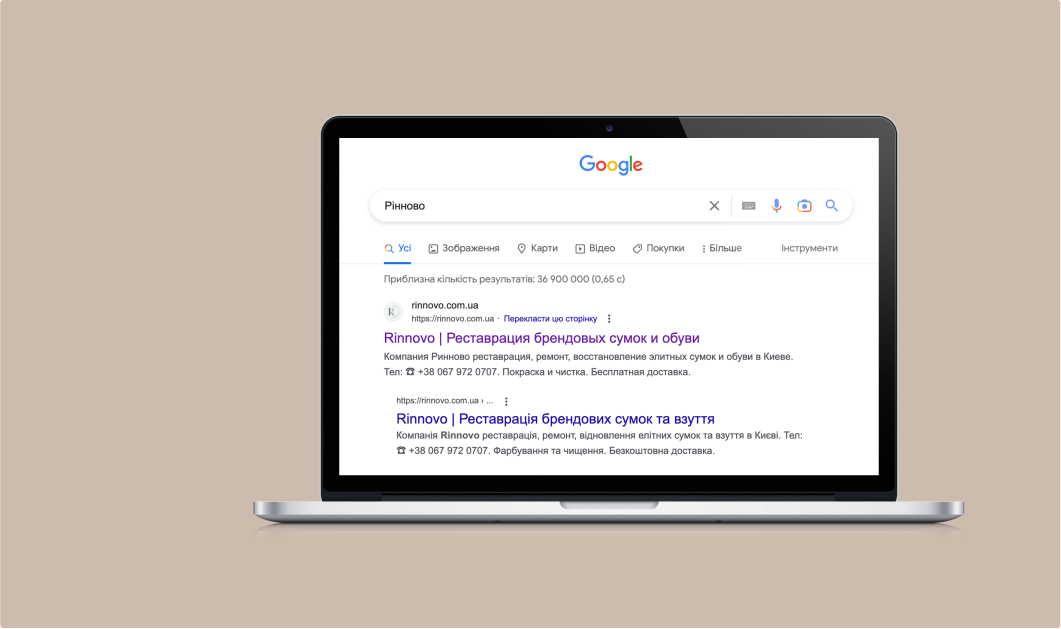
Search Engine Optimization (SEO) is a set of activities aimed at improving your website's positions in Google’s organic search results. You do not pay for every click, but you invest time and resources into creating high-quality content, technical optimization, and gaining authoritative backlinks. Results appear gradually but work in the long term.
PPC advertising (Google Ads) refers to paid advertisements in Google search results and across Google's partner websites. You pay for every click on your advertisement. Results appear immediately after launching a campaign but disappear as soon as funding stops.
The key difference lies in the speed and duration of the effect. SEO is a marathon where every hour of work invested creates an asset that can generate results for years. PPC advertising is a sprint where you get customers here and now, but only as long as you continue paying.
How Search Changed in 2026
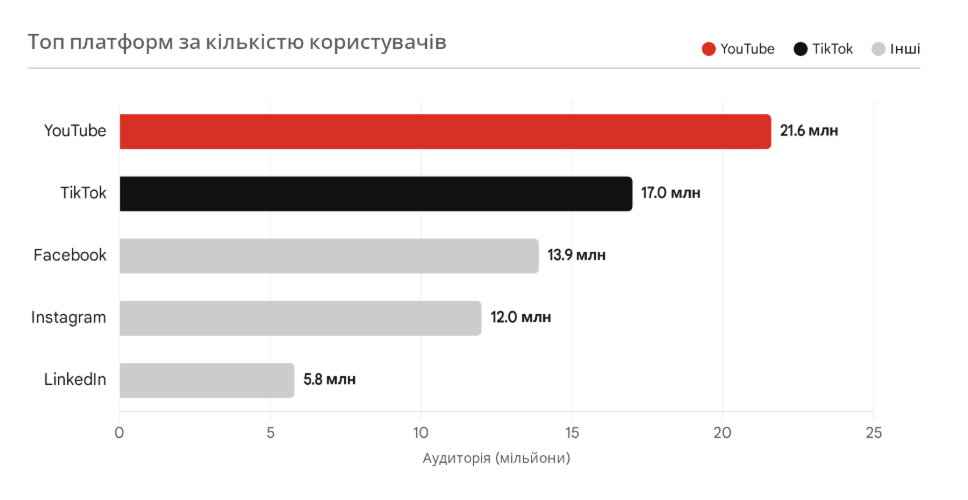
The Ukrainian digital landscape has undergone significant transformation. According to the Digital 2026 Ukraine study, more than 21.6 million Ukrainians actively use YouTube, while 17 million use TikTok. This means that search is no longer limited to Google — your customers look for information across various platforms.
Moreover, Google introduced AI Overviews — blocks of answers generated by artificial intelligence that appear directly in search results. Users increasingly receive answers without visiting a website. This changes the very essence of SEO: now it is important not only to rank at the top but also whether artificial intelligence cites your content in its responses.
When SEO Delivers the Greatest Results
Organic optimization proves to be most effective in several scenarios:
Long sales cycle. If your customers make purchasing decisions over weeks or months (B2B services, complex equipment, real estate), SEO allows you to guide them through every stage. From the first informational searches like "how to choose..." to final commercial searches such as "buy in Kyiv".
Limited but stable budget. For small and medium-sized businesses, SEO allows results to accumulate over time. Unlike advertising, where stopping payments means an immediate loss of traffic, an optimized page can continue attracting visitors for years without additional investments.
Expert-driven industries. In fields where trust and proof of expertise are essential (legal services, healthcare, financial consulting), strong organic rankings serve as an additional signal of credibility. In 2026, Google actively applies the E-E-A-T principles (Experience, Expertise, Authoritativeness, and Trustworthiness) to evaluate content quality.
Informational searches. People searching for phrases such as "how to choose...", "what is better...", or "guide..." are at the beginning of their customer journey. Capturing this traffic through SEO allows you to build trust before the purchase decision is made.
When PPC Advertising Is Irreplaceable
PPC advertising proves its value in other situations:
Fast launch. A new business or a new product launch requires immediate results. Google Ads allows you to get your first visitors on the very day a campaign goes live, while SEO may only show noticeable results after several months.
Seasonal offers. Promotions, sales, and limited-time offers require immediate audience engagement. SEO simply will not have enough time to bring your page to the top before the campaign ends.
Demand testing. Before investing in content creation and an SEO strategy, it is wise to test demand through PPC advertising. Within just a few days, you can see which offers attract interest and which ones fail to engage your audience.
Precise targeting. If your audience is clearly defined (for example, apartment owners in a specific district of Kyiv aged 30–45), PPC advertising allows you to reach exactly those users without wasting your budget.
Comparison Table: SEO vs PPC Advertising
↔️ Scroll the table sideways to view all the data
| Criterion | SEO | PPC Advertising |
|---|---|---|
| Speed of results | 3–6 months | 1–3 days |
| Payment model | Fixed cost of work | Pay per click |
| Duration of effect | Years (with ongoing support) | Only while ads are running |
| User trust | Higher (organic search results) | Lower (“Sponsored” label) |
| Control | Limited (depends on Google) | Full (budget and targeting) |
| Predictability | Difficult to predict exact results | Predictable cost per click |
The Reality of the Ukrainian Market in 2026
Ukrainian businesses operate under unique conditions. On the one hand, competition in many industries has increased — many companies have restored or strengthened their digital presence. On the other hand, consumers have become much more demanding regarding the quality of information and brand transparency.
Research shows that Ukrainians carefully verify information before making a purchase using various channels. A typical customer journey may look like this: discovering a product on TikTok, watching a detailed review on YouTube, reading reviews on Google, and then finding the company’s website through search.
This confirms the main idea: a successful strategy in 2026 is not about choosing between SEO and PPC but integrating all channels where your brand is present.
How to Combine SEO and PPC Advertising: A Synergy Strategy
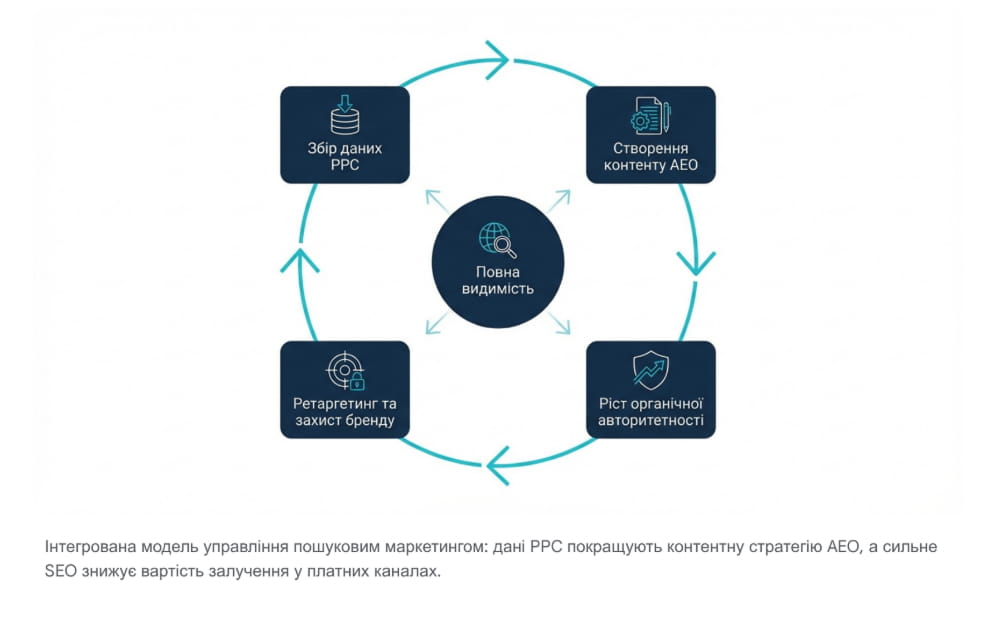
The smartest approach is to create a closed-loop system where each channel strengthens the other:
Stage 1: Start with PPC. Launch Google Ads to quickly test demand. Paid advertising will help you understand within one or two weeks which offers resonate with your audience, which queries convert into leads, and which bring irrelevant traffic.
Stage 2: Analyze data for SEO. Search term reports from PPC campaigns are a goldmine for your SEO strategy. You can see real user queries, their wording, and their questions. Use this data to create content that directly addresses your audience’s needs.
Stage 3: Work in parallel. Paid advertising continues to bring customers while SEO gains momentum. Create landing pages, write expert articles, and optimize the technical aspects of your website. At the same time, strong organic rankings can improve paid campaign performance — users are more likely to click on ads from brands they have already seen in organic search results.
Stage 4: Optimize your budget. Once SEO starts consistently generating traffic for certain queries, you can reduce PPC spending on those keywords. Redirect the freed-up budget toward promoting new products or competing for more expensive, high-value search terms.
Common Mistakes When Choosing a Channel
Many business owners make similar mistakes:
Mistake 1: Expecting instant results from SEO. SEO is an investment in the future. If you expect to reach top positions within a month, disappointment is inevitable.
Mistake 2: Rejecting PPC advertising because it is "too expensive". If a customer generates profit for your business, the question is not how much a click costs, but what the return on your customer acquisition is. Even an expensive click can be profitable.
Mistake 3: Ignoring analytics. Without tracking conversions, it is impossible to understand which channel performs better. Set up Google Analytics and a lead tracking system.
Mistake 4: Working without a strategy. Running SEO and advertising without a systematic approach is a waste of money. You need a clear plan: which search queries you target, who your audience is, and which conversion actions you track.
What Should Your Business Choose: Practical Recommendations
The choice of strategy depends on the specifics of your business:
If you are just launching your business — start with PPC advertising to validate your idea and acquire your first customers. At the same time, build the foundation for SEO: a high-quality website, basic optimization, and the first blog articles.
If you have a stable business with consistent demand — invest in SEO to reduce customer acquisition costs in the long term. Use PPC advertising for scaling and seasonal offers.
If you operate in a competitive niche — combine both channels from day one. High advertising costs in competitive industries make SEO not just an option but a necessity for survival.
If you have a local business — prioritize local SEO (Google Business Profile, reviews, and local backlinks) along with local advertising campaigns using geographic targeting.
How the Role of an Agency Has Changed in 2026
A modern digital agency is no longer simply a contractor performing individual tasks ("set up PPC campaigns" or "do SEO"), but a strategic partner that builds a comprehensive ecosystem of a brand’s online presence.
Clients no longer buy "rankings" or "clicks"; they invest in business growth. Therefore, an agency must understand the client’s business economics, profit margins, customer lifecycle, and develop a strategy based on business objectives rather than purely marketing metrics.
At MAS Agency, we help businesses build a balanced promotion strategy where SEO and PPC advertising work as a unified system. We analyze your market, competitors, and product specifics to offer a solution that delivers measurable results.
Conclusion: Integration Instead of Choice
The question "SEO or PPC advertising?" has lost its meaning in 2026. The right question is: "How can these channels be combined for maximum effectiveness?"
PPC advertising delivers fast results and valuable data. SEO builds a long-term asset and reduces dependence on paid channels. Together, they create a synergy where every dollar of the marketing budget works more effectively.
The Ukrainian digital market is becoming increasingly complex and competitive. The winners are those who understand the specifics of each channel, know how to analyze data, and build a comprehensive presence strategy across all platforms where their target audience is located.
Ready to discuss a strategy for your business? Contact MAS Agency for a free consultation — we will analyze your current situation and offer a specific action plan.
Sources:
• Digital 2026 Ukraine (platform user data)
• Google Business Profile (digital marketing trends in 2026)
• Search Engine Land (PPC trends 2026)