Video Marketing for Small Business: What to Shoot and Where to Publish




More than three-quarters of search sessions end without a click-through to a website — algorithms provide answers directly within the search results. Where, then, is the purchasing decision formed? Meta data points to short-form video feeds: demand is generated there long before a person forms a conscious search query. For small businesses, this means one thing: video marketing is no longer just a "nice addition" to the strategy. It is the primary channel where the customer's choice is determined.
Numbers That Make It Hard to Wait
According to Wyzowl, 93% of companies already use video as a marketing tool, and 95% of marketers consider it critical for business. HubSpot reports that short vertical videos generate the highest ROI at 49%, outpacing long-form formats (29%) and live streams (25%).
The correlation between duration and attention span is direct: videos under one minute retain 50% of viewers, while one-hour material holds only 17%. Integrating a video into a landing page increases conversion rates by 80–86%, and visitors who watch a product demo are 97% more likely to buy. This is the current state of the market, not just forecasts.
Which Platform for Which Business
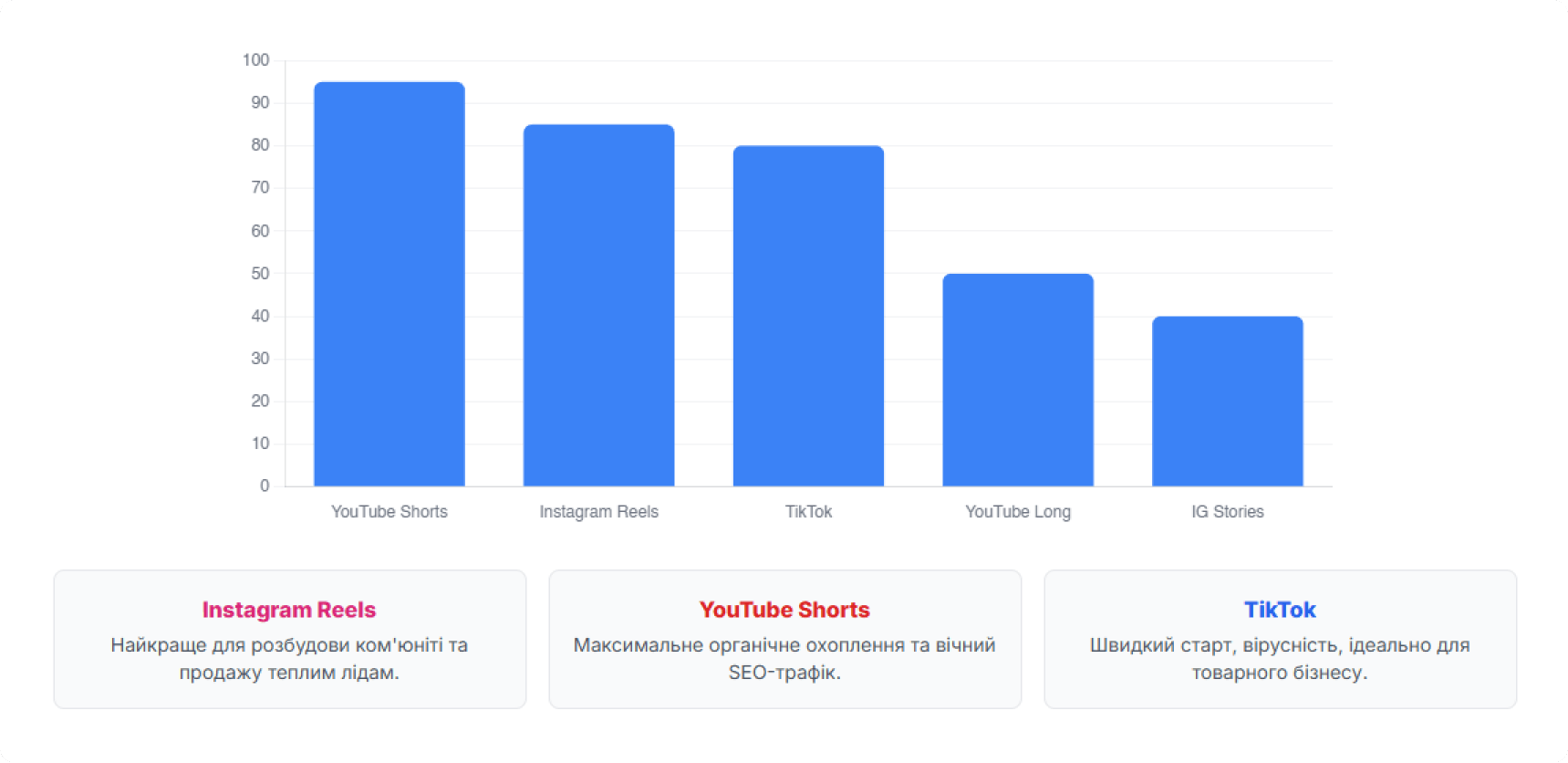
LinkedIn is the priority for B2B. The average engagement rate for video on LinkedIn stands at 5.6% — the highest across all platforms. In 2026, the platform introduced a dedicated vertical feed that prioritizes content based on relevance rather than just connections. A key nuance: native video uploaded directly to LinkedIn receives five times more reach than a link to YouTube. The optimal duration is up to 60 seconds.
TikTok and Instagram Reels are for B2C. TikTok's engagement rate is 3.7%, which is eight times higher than classic Instagram (0.48%). TikTok Shop allows embedding clickable product tags directly into the video — a format that increases conversion rates by 20% compared to static posts.
YouTube is indispensable for educational content: 51% of B2B buyers search for answers here before closing a deal.
What to Shoot on a Low Budget
Audiences are tired of over-edited content and reward authentic videos instead. Here are three formats proving that budget is not the primary factor.
UGC (User-Generated Content). 84% of consumers trust brands that display videos from real customers. The CTR of such ads is four times higher than studio-produced ones. A practical tactic: offer a discount or bonus in exchange for an honest video review shot on a smartphone's front-facing camera.
"In the Moment" (Behind-the-Scenes). Raw clips of daily work: packaging an order, a comment from the founder straight from the production floor. This format requires zero budget but transforms an ordinary company into a team people want to trust.
Educational Series. 73% of users watch educational videos before buying. Gather the 10 most common customer questions — and you have a ready-made content plan for two months. According to Wyzowl, this format also significantly reduces the workload on customer support services.

The First 3 Seconds Matter — No Exaggeration
63% of the most effective ad videos deliver their main message within the first three seconds. 45% of viewers who cross this threshold stay for at least another 30 seconds. A video that begins with a static speaker saying "Hello everyone, today I will tell you..." loses more than half of its audience before the first sentence is finished.
Effective hook formulas include: appealing to the fear of loss ("You are doing this wrong, and it is costing you customers"), curiosity gap ("No one talks about this approach, but it changes everything"), or direct targeting ("Stop scrolling if you are a local business owner in Kyiv").
Another crucial nuance: between 75% and 85% of videos are watched without sound. Captions are not an option; they are a technical requirement.
The Minimum Equipment Setup
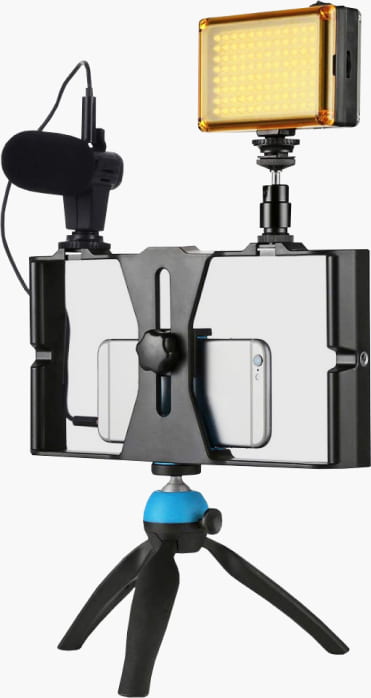
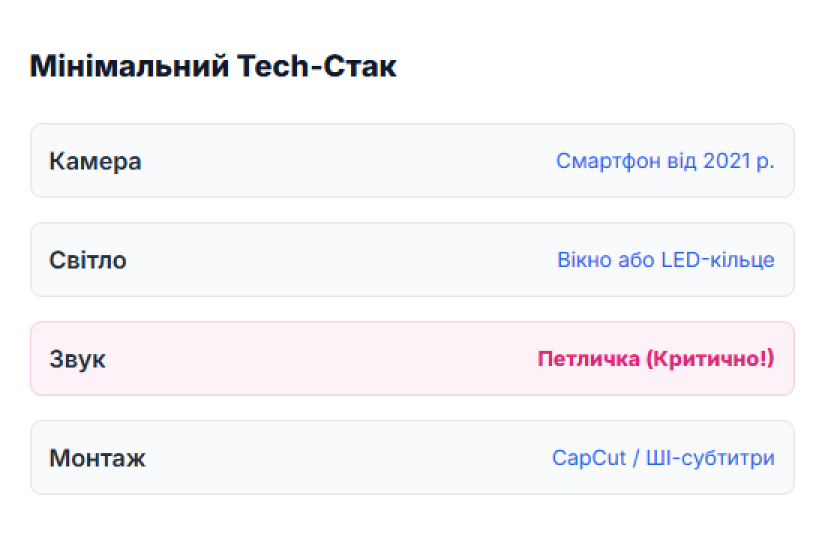
A flagship smartphone completely replaces a dedicated camera for social media marketing. The only rule: shoot with the main (rear) camera — it is physically larger and provides a better picture in low-light conditions.
The weak spot of smartphones is audio. Viewers will forgive an unstable frame, but they won't tolerate noise and echo. A wireless lavalier system (DJI Mic or Rode Wireless GO) solves this problem in any environment. For office setups, a USB microphone is quite enough. As for lighting: natural light from a window or a basic LED panel positioned at a 45° angle to the face will do the job.
From Views to Money
17% of companies do not measure the effectiveness of their video marketing at all. Most others stop at "vanity metrics" — likes and views that correlate poorly with actual revenue.
A practical approach involves three levels of measurement aligned with the funnel. The top of the funnel tracks completion rates and unique audience reach. The middle tracks click-throughs and form submissions. The bottom tracks cost per acquisition (CPA) and sales conversion. ROI is calculated standardly: ((Video Revenue – Production & Promotion Costs) / Production Costs) × 100. The minimum evaluation window is 90 days: educational content accumulates views for months after publication.
Video marketing for small business is not about expensive production value. It is about consistency, choosing the right platform, and those first three seconds that stop the scroll. A smartphone, a lavalier microphone, and a clear hook structure are the absolute minimum to get started. The rest is a matter of system and analytics.
Sources: The analysis is based on Wyzowl video marketing statistics for 2026, the HubSpot marketing trends report, Whitehat SEO video benchmark research, Meta materials on marketing trends for 2026, and Distribution AI analysis on hook mechanics and platform algorithms.