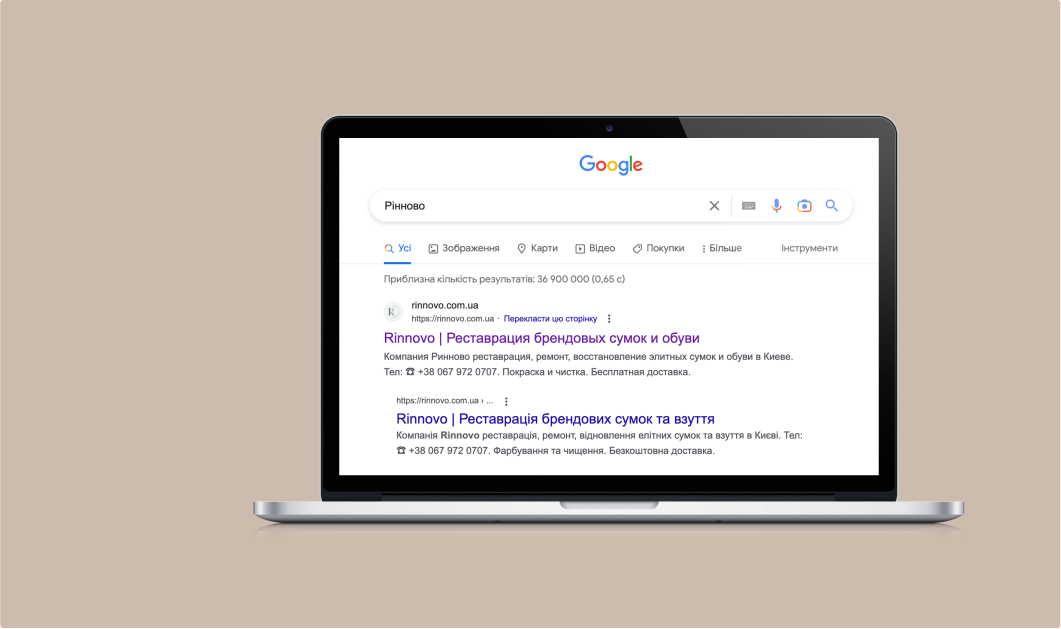
SEO in the Era of AI Search: How Brands Can Avoid Vanishing from Google SERPs


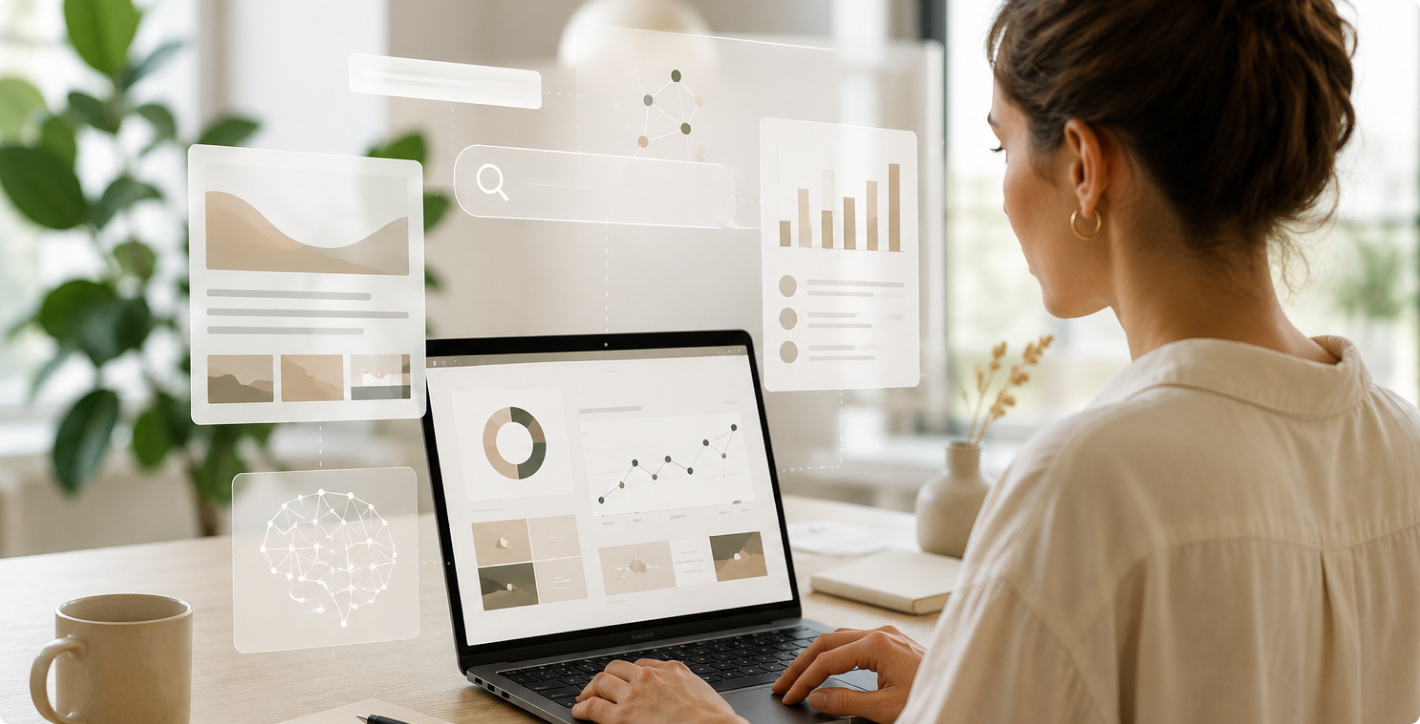
On May 19, 2026, at Google I/O, the company announced the most significant transformation of its search bar in over 25 years. Liz Reid, Head of Google Search, called it "the biggest update to the iconic search bar since its inception." It understands not just words, but images, files, and browser tabs — delivering an AI-generated text response instead of a traditional list of links. For a business owner, this is not a cosmetic change; it is a fundamental shift in the logic of how clients find you. Let's break down what to do — without panic and without hype.
Two Systems Now Dictating Your Visibility
Google runs two AI systems in parallel, and they should not be confused.
• AI Overviews — a generated response displayed above the organic search results. According to Google, it is viewed by approximately 2.5 billion users monthly.
• AI Mode — a conversational interface utilizing follow-up questions. In May 2026, Google reported that AI Mode crossed the milestone of 1 billion monthly users.
Crucial takeaway for business owners: classic search is not going anywhere. Liz Reid explicitly emphasized that the new search bar "does not mean you will only receive AI answers." The traditional ten blue links are still there — they simply share screen real estate with the machine-generated answer now.
What This Means for Traffic
AI answers are expanding rapidly: over the past year alone, their coverage grew by nearly 58%, now encompassing roughly half of all Google searches. This means coming across a ready-made machine response is no longer a minority experience, but a reality for almost every second user.
The direct consequence is clear. When an AI Overview sits atop the SERP, users click on standard organic links half as often — roughly in 8% of cases instead of 15%. Meanwhile, fewer than 1% of users click through to a source cited inside the AI answer itself. Consequently, traffic is declining even for brands that consistently hold top positions.
Less Traffic — But Higher Quality
This paradox becomes less frightening when you look at the revenue: visitors coming from an AI assistant convert on average 4.4 times better than standard organic traffic (Semrush). Furthermore, according to Adobe Analytics, AI-driven retail traffic surged by 393% year-over-year in the first quarter of 2026, and in March, these visitors converted 42% better than everyone else.
The reason is simple: the AI has already compared, filtered, and summarized options for the user, meaning the user arrives at your site as a highly qualified lead. The conclusion for managers: do not panic over dropping visit numbers — recalculate your revenue per visit and conversion rate by channel.
Three Surfaces Where Your Brand Must Be Present
In the past, SEO came down to one thing — hitting the top spots. Today, a brand must win on three distinct levels:
1
Classic SERP.
Still active and providing foundational baseline traffic.
2
Citations in AI Answers.
Becoming the source that the AI extracts and names within its response.
3
AI Agent Decisions.
At I/O 2026, Google announced Information Agents — assistants that monitor prices and offerings 24/7 to compile summaries, as well as Universal Cart, which allows the AI to assemble a shopping cart and check out on behalf of the user.
This third level poses a new question: how does my brand look to an autonomous agent that will read the website once and never send an actual human visitor?
Eight Paradigm Shifts: How the Rules of the Game Are Changing
When distilling this new logic into simple "Before → After" pairs, the landscape looks like this:
| Parameter | Before (Classic Search) | Now (AI Search Era) |
|---|---|---|
| Primary Goal | Ranking in the organic Top 3 | Being cited as a source in the AI answer |
| Key Metric | Keyword-driven organic traffic | Brand mention and citation frequency |
| Discovery Channel | Browsing the ten blue links | A single comprehensive response or AI Mode dialogue |
| Content Format | Long-form articles optimized for keywords | Direct answers, FAQs, clear logical structure |
| Authority Signals | Backlinks and Domain Authority | Reviews, community mentions, third-party platforms |
| Customer Journey | Visiting 5–8 pages before purchasing | 2–3 touchpoints: AI condenses the research phase |
| Traffic Volume | Maximizing "raw" organic sessions | Fewer visits, but with significantly stronger intent |
| Who "Reads" Your Site | Human users exclusively | Humans alongside AI agents acting on their behalf |
What Actually Helps You Get Featured in AI Responses
The good news: classic SEO isn't dead — it has become the foundation upon which new optimization strategies are built:
• Direct Answers. The first paragraph directly following a question-based heading should contain a concise, self-contained answer of 40–60 words.
• External Validation. Reviews on G2, Capterra, Trustpilot, alongside a presence on Reddit and Wikipedia — these are the external platforms AI engines cite most frequently.
• E-E-A-T (Experience, Expertise, Authoritativeness, Trustworthiness) — explicitly named authors, verified real-world case studies, and original data, rather than rephrasing third-party content.
• Structured Data (Schema). In an official guide released on May 15, 2026, Google explicitly stated that schema markup is not required for AI search features, though it remains highly recommended to secure rich results in traditional search layout.
An important caveat: the `llms.txt` file, often marketed as the "new robots.txt for AI," was labeled redundant by Google in the very same guide. Do not waste your budget on it.
What is Already Live in Ukraine
Technologies roll out unevenly across regions. Here is the realistic status update as of May 2026:
• AI Overviews in Ukrainian — live since May 20, 2025.
• AI Mode — live in English since August 2025, and in Ukrainian since October 2025.
• Search Live (camera and voice-driven search) — active since March 26, 2026.
• Personal Intelligence (personalization features integrated with Gmail, Photos, and Calendar) — available for free since May 19, 2026.
• Information Agents and Universal Cart — currently exclusive to the US; followed by Canada and Australia. Google has not yet announced a timeline for Europe or Ukraine.
One More Thing: A Core Algorithm Update Is Underway
On May 21, 2026, almost simultaneously with the I/O keynotes, Google launched a major Core Update to its ranking systems. While it is not directly tied to the I/O announcements, the overlapping timing means keyword positions might fluctuate wildly. Our advice: avoid making abrupt technical site changes during the first week — impacts can only be accurately assessed once the rollout fully concludes.
Three Questions to Determine Your Next Strategic Move
1 What percentage of your target queries already trigger an AI Overview? If it is under 10%, continue focusing on classic SEO. If it is over 30%, AI optimization shifts to your top priority.
2 Does your business involve long sales cycles? B2B, professional services, and high-ticket purchases see the highest conversion premiums from AI search traffic. Impulse buys are still largely dominated by standard organic results.
3 Is your baseline SEO hygiene up to par? Without ranking in the traditional organic Top 10, the likelihood of an AI model pulling your site as an answer source is minimal — tackle technical SEO and foundational content first.
Businesses adapting now are gaining a major head start. In upcoming pieces of this series, we will break down monitoring tools to evaluate visibility inside ChatGPT, Gemini, and Perplexity, alongside prompt research methodologies. Ultimately, the new search paradigm will not be won by those who treated SEO as a one-off keyword optimization project, but by those who approach SEO as a continuous, evolving process: monitoring algorithmic changes, updating content, and building trust signals that AI systems interpret as verification to showcase that specific brand. This requires long-term, systemic effort — and it is exactly the philosophy behind the SEO services at MAS Agency.
Sources Cited