Structured Data in 2026: What Works and What Google Has Already Buried




There is a strange situation around structured data right now. Some say that micro-markup is "dead" and there is no point in doing it anymore. Others claim it is your only ticket into AI answers. Both positions are wrong. Let's look into what has actually changed and what a business owner should do about it.
What It Is in Simple Terms
Structured data (also known as schema markup or micro-markup) is code on a page that is invisible to visitors but explains to the search engine exactly what it is looking at: a product with a price, an article with an author, or a local business with an address and working hours. The most common format is JSON-LD: a separate block of code that doesn't change the design of the site but gives Google a machine-readable description of the content.
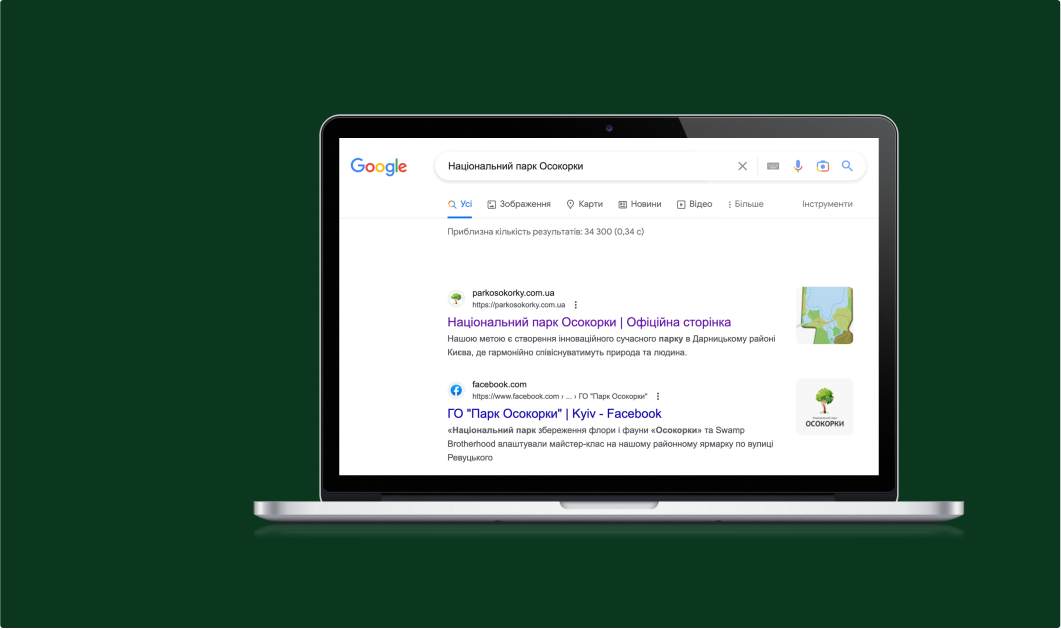
Previously, the main motivation was chasing "rich results" — those visual enhancements in the search results: rating stars, prices, breadcrumbs, and Q&A blocks. This is exactly where the years 2025–2026 turned everything upside down.
Why 2026 Is a Turning Point
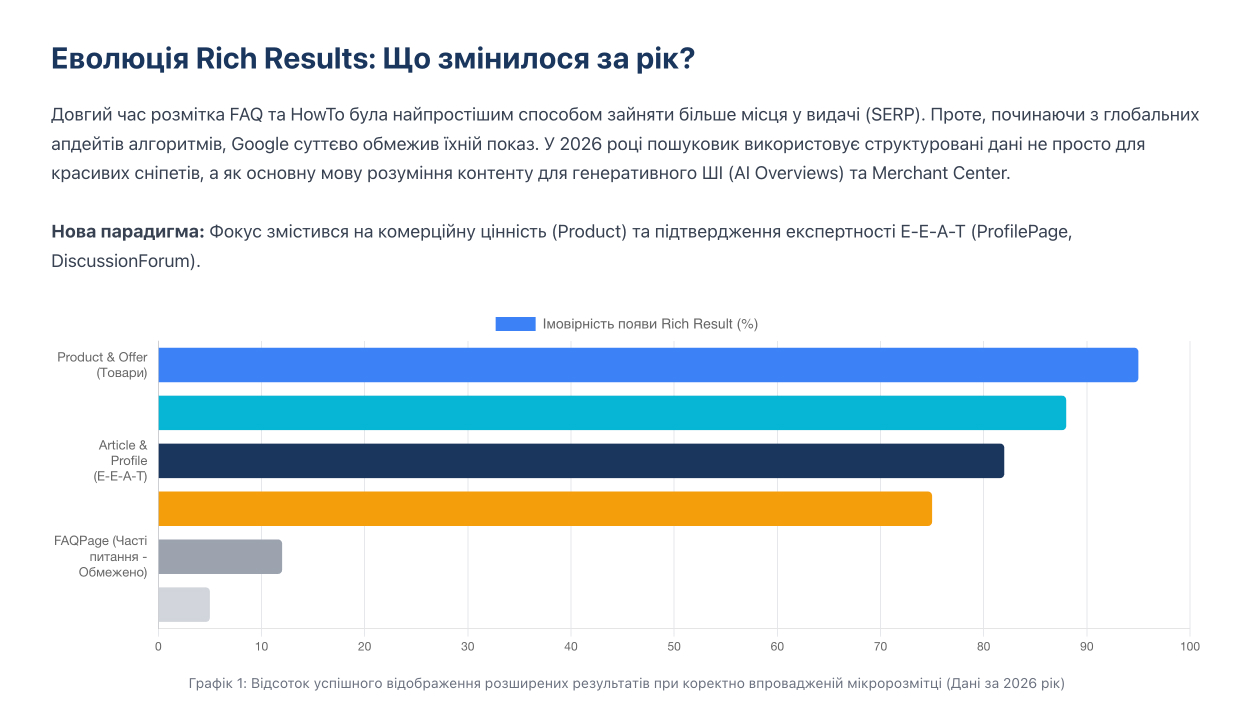
Google has been consistently removing visual "decorations" from search results. On May 7, 2026, rich results of the FAQ type completely disappeared — for all websites without exception. Earlier, in 2023, the same fate befell HowTo (step-by-step guides). Back in June 2025, Google removed support for seven markup types at once: including Course Info, Estimated Salary, Vehicle Listing, and other niche formats.
An important nuance: the FAQ or HowTo code itself doesn't "break" on the website and isn't penalized — it simply no longer provides anything in the search results. So, if someone advises you to urgently "add FAQ markup for the sake of snippets," this is advice from back in 2022.

What Structured Data Does NOT Do
This is where the most interesting part begins — and this is exactly what sellers of "magic solutions" stay silent about.
First: schema is not a ranking factor. Google explicitly confirms this — markup does not raise a website in search results by itself.
Second, and unexpected: structured data does not automatically open the door to AI answers. Google's official documentation explicitly states that no special schema is required to get into AI Overviews. Furthermore, when Ahrefs compared 1,885 pages that added markup against 4,000 control pages in May 2026, the increase in AI citations turned out to be statistically zero. Individual agency case studies promise hundreds of percent, but they are not reproducible in independent research.
The sober conclusion: micro-markup is not a "make me visible to AI" button. Visibility is driven by the authority and relevance of the content, not the code itself.
What They Realistically Provide
At the same time, throwing out structured data is also a mistake. In 2026, it provides three very concrete things.
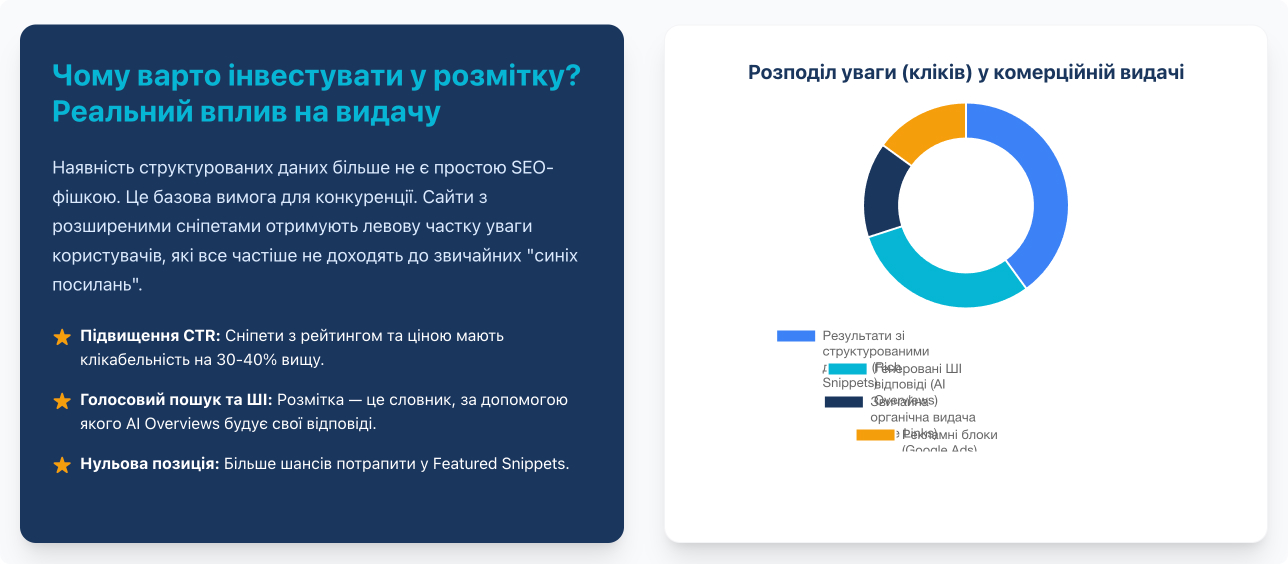
First, the rich results that remain still increase click-through rates: rating stars and prices for products, breadcrumbs, and local business cards. According to industry estimates, product snippets with price and rating add about 20–30% to CTR — which translates to free traffic from the exact same position in search results.
Second, clear identification of the business. Without markup, a brand name is just a string of text to the algorithm. Organization and LocalBusiness markup tells the system: this is a specific company, here is its website, address, and phone number. For AI systems trying to verify a source, this is a trust signal. Third, correct fact reading — who the author of the article is, when it was updated, which price is current — so that the algorithm doesn't misinterpret the page.
The practical minimum for a typical small business website looks like this: Organization (who you are), LocalBusiness (if there is a physical location — a coffee shop, salon, clinic), Product and Review (if you sell online), Article (for the blog), and BreadcrumbList (navigation). Everything else is as needed, without fanaticism.
How to Implement Without a Developer and Verify
Writing code by hand is not necessary today. On WordPress, plugins handle this (Rank Math, Yoast, All in One SEO), and on Shopify — specialized apps that update markup automatically along with prices and stock levels.
After implementation, verification using two tools is mandatory. Google's Rich Results Test shows exactly which visual results the page qualifies for. The Schema.org Validator checks syntax and identifies logical errors. Next up is the "Enhancements" report in Search Console for continuous monitoring.
And the golden rule of 2026 is content parity: everything embedded in the markup (prices, reviews, author's name) must be actually visible on the page. Google treats discrepancies between code and content as spam and may impose manual sanctions, after which all markup on the site will be ignored. Markup describes a page — it doesn't invent what isn't there.

Conclusion
Structured data in 2026 is no longer a trick to grab extra space in search results, but basic website hygiene: a way to be correctly understood by humans, algorithms, and AI systems alike. The game has shifted from "gaming the snippet" to "cleanly and honestly describing who you are and what you offer." This is not a one-time action, but a part of technical SEO that requires correct implementation and regular checks — which is exactly what SEO optimization by MAS Agency is built upon.
Sources:
Google Search Central (structured data documentation and FAQ deprecation, May 2026), Search Engine Journal (chronicle of FAQ cancellation and seven markup types deprecation), Ahrefs (study on schema impact on AI citations, May 2026), Search Engine Land (deprecation of seven markup types, June 2025).