How to Build an Online Sales Funnel: From the First Touchpoint to Purchase



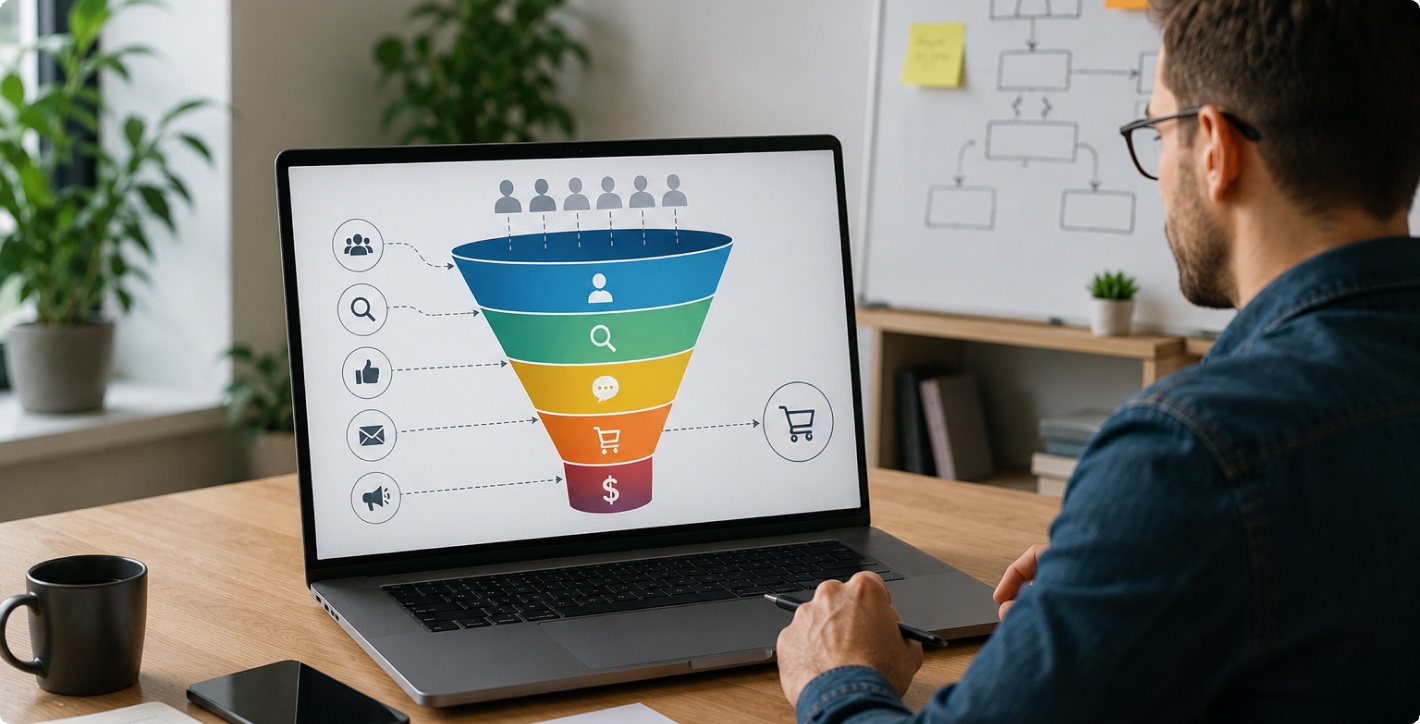
A sales funnel is the journey a person takes from the moment they first hear about you to the moment they make a purchase. The name is fitting: a lot of interested people enter at the top, and a smaller share of them buy at the bottom. The task of a business is not simply to pour as many people into the funnel as possible, but to understand at which stage and why they drop off.
Four Stages, But No Longer Monorails
Classic logic describes four stages: attention, interest, decision, and action. First, a person learns about a brand, then takes a closer look at the offer, compares options, and finally buys. As a mindset, this model is still useful. However, in 2026, it works more like a map than a fixed monorail.
The real customer journey is non-linear. A person might see an ad, forget about it, return a month later via search, read reviews, disappear again — and finally buy after receiving an email newsletter. Therefore, it is better to visualize a funnel not as a staircase, but as a set of stages between which the customer roams freely.
Which Channels Work at Each Stage
At the attention stage, social media, videos, content, and broad-audience advertising do the work — here, the goal is not to sell, but to get noticed. A crucial nuance of this year: according to a study by SparkToro, about 68% of Google searches end without a click to a website — people get their answers directly within the search results. Thus, the first touchpoint increasingly happens outside of search engines, occurring where attention actually lives: in feeds, videos, and mentions.
At the interest and decision stages, more precise tools kick in: retargeting (showing ads to those who have already visited the site), emails, case studies, and answers to typical objections. At the action stage, everything is determined by a user-friendly website or landing page where nothing gets in the way of leaving an inquiry or making a payment.
The Power of a Funnel Lies in Connections, Not Channels
Separate channels do not yield results until they are interconnected. Advertising brings a person to the website, the website passes the lead to a CRM — a system where all inquiries are stored — the CRM reminds the manager to call back, and email brings back those who didn't complete their purchase. When these systems are disconnected, a business pays for advertising but remains blind to which channel actually brings in customers — effectively optimizing in the dark.
For companies operating in the EU market, another layer is added — consent for data collection. As of this week, Google is changing the data transfer rules between its analytics and advertising platforms: without properly configured user consent, a portion of advertising data simply won't be collected. While this is currently less critical for purely Ukrainian businesses, the trend is obvious — without data, a funnel goes blind.
Where Customers Are Lost Most Frequently
The largest drop-off doesn't happen at the start, but right near the purchase. In e-commerce, this is evident from the numbers: according to a meta-analysis by Baymard Institute, an average of about 70% of shopping carts are left abandoned. The reasons are mostly manageable. The primary culprit is hidden costs: when shipping, taxes, or fees suddenly appear at the final step, nearly half of the buyers walk away. The next most frequent reasons are mandatory registration requirements and unclear or overly long delivery times. On mobile devices, the abandonment rate is even higher, as an inconvenient checkout process on a small screen deters users fastest.
The conclusion here is simple: before pouring more money into advertising, you should patch up what is leaking. Clear final pricing, an option to buy without registration, a short checkout process, and a quick response to inquiries often yield a bigger lift than increasing the budget.
Ultimately, a funnel is not just a diagram on a board, but a system that needs to be assembled from advertising, the website, and analytics so that they work together and show you exactly where you are losing money. A traffic source that brings in the right people and a landing page that doesn't waste this traffic are the two most critical links in the funnel in terms of consequences. It makes perfect sense to delegate them: configure online advertising and landing page creation from MAS Agency.
Sources: share of zero-click searches — SparkToro / Similarweb study (2026); cart abandonment statistics and reasons — Baymard Institute meta-analysis; Google Analytics → Google Ads data transfer changes — official Google Analytics help documentation (effective June 15, 2026).