NGO Communications in Ukraine: How Nonprofits Build Donor Trust



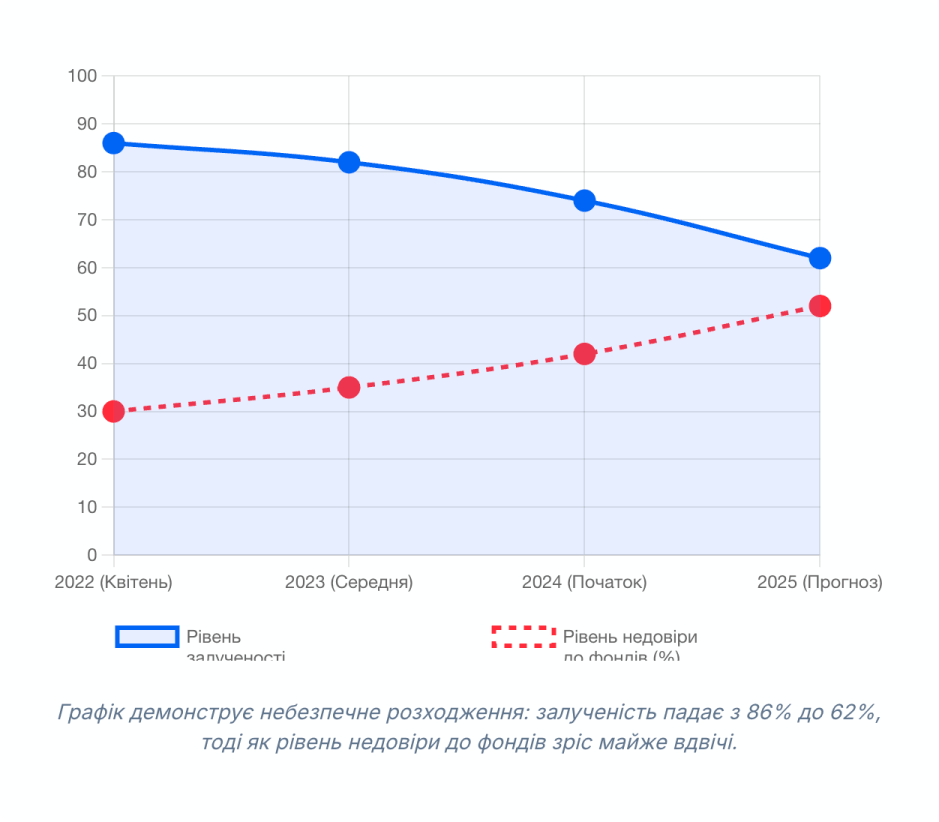
Ukrainian charitable giving is not fading — it is becoming more demanding. According to Zagoriy Foundation and the SOCIS research centre, 62% of Ukrainians took part in charitable giving in 2025, down from 85–86% a year earlier, while distrust of foundations has nearly doubled in three years — from 30% to 52%. This is not indifference: donors have stopped giving on emotion and started asking who you are, what you have done, and where the report is. The MAS Agency team has spent several years serving as the external press office and communications department of Razom for Ukraine, so we see this shift from both sides — in the research data and in a foundation's daily work. The main lesson is simple: trust is built by systems, not by the size of an organization.
Why NGOs lose the communications game
They lose not to business, but to their own lack of system. Telling your story "when there is time" still worked in 2022, on the wave of unity. But according to the Council on Foreign Relations, US aid to Ukraine was cut by 74% in 2025, and, as an ACAPS report shows, local organizations without donor diversification were hit hardest. In these conditions, communications is not "PR" — it is donor diversification in the most literal sense: an organization known to donors, media, and partners does not collapse when a single grant disappears.
Who your organization is really talking to
An NGO has at least four audiences — and each needs its own communication.
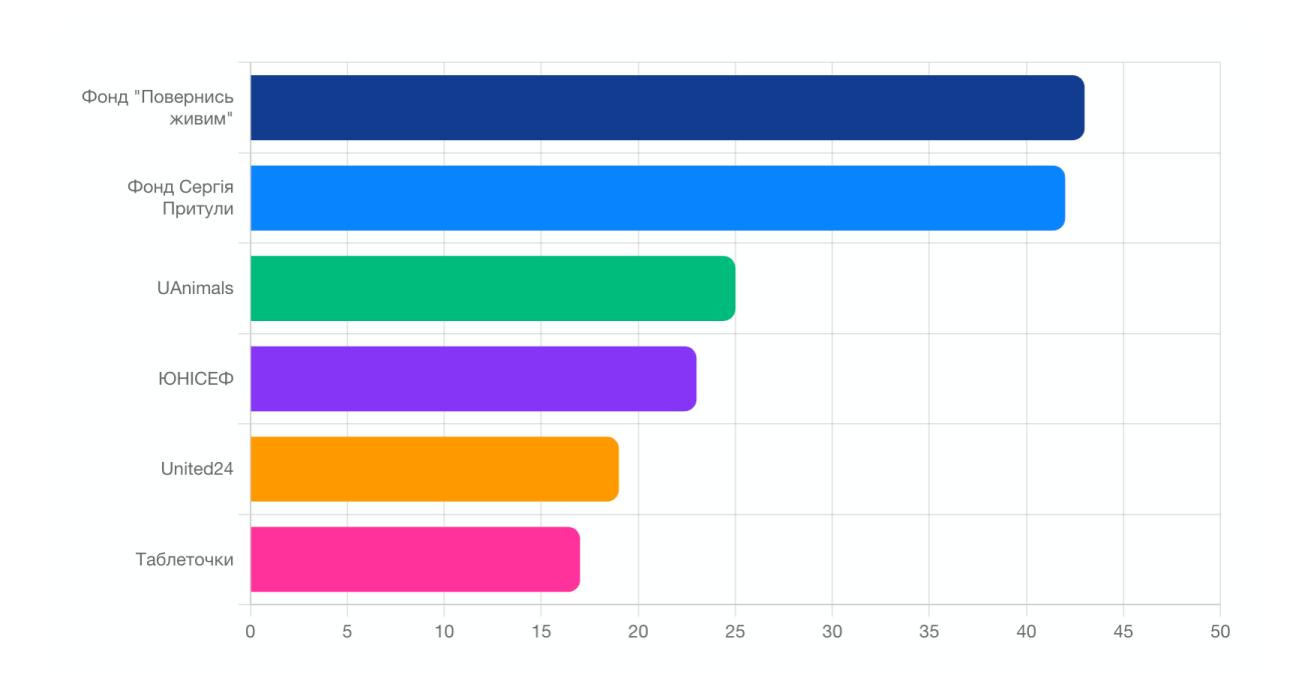
Local donors give not to the biggest, but to the clearest. A March 2026 poll by Slovo i Dilo found that recognition of the sector's leaders exceeds 93%, yet trust in them varies widely. Recognition without transparency does not convert into donations.
International and institutional donors make decisions through due diligence — a comprehensive vetting of the organization. Its first stage happens without you: the reviewer studies your digital footprint. A website with no reports, address, or team, a social-media-only presence, no English version — these are red flags that close doors before the first meeting.
Beneficiaries are not "faces for fundraising". The modern standard is ethical storytelling: a story is told with the person's consent and respect for their dignity, and the organization acts as a partner, not a savior.
Media need sources, not press releases. The standard playbook says "build a journalist database and send press releases". In our work with NGOs we abandoned that approach: a one-off press release competes in a journalist's inbox with dozens of identical ones. Instead, we build presence at permanent media venues — press events there have a cumulative effect: journalists get used to the organization as a source and eventually come asking for comment themselves. It is slower than a mailout, but it creates a foundation that works for years.
The minimal communications system
The minimum without which a foundation is invisible: a website with reports and payment details, one systematically run social media channel, regular impact reporting — not once a year, donors want to see progress continuously — and a living media contact base. We know the particular challenge of multi-project foundations well from our work with Razom: with dozens of programs, each naturally wants its own voice — and without a unified content system and shared visual style, the audience sees scattered news rather than the systematic work of one foundation. That is why we put identity and a unified tone of voice before scaling the volume of publications: more content without a system only amplifies the chaos.
What to do with no budget
With no budget, focus beats dispersion: one platform instead of five, stories of people and results instead of "support us", volunteers and beneficiaries as ambassadors. In the fundraising collaborations with creators that we supported, one rule holds consistently: the goal must be concrete and clear to the audience — "raising for everything" fails even with major media personalities. Regular small community gatherings are another underrated format: in our practice they generate partnerships more reliably than one-off large events, because partnership grows out of acquaintance, not a presentation. And the reserve most foundations ignore: converting one-time donors into recurring subscribers — according to Zagoriy Foundation, only about 14% of donors currently choose recurring giving, although recurring payments are what give a foundation predictability.
When to delegate
Delegate communications not when "there is no time", but when the cost of error grows. Three triggers: dependence on one or two donors (communications is diversification), entering international funding (due diligence demands an institutional level of presentation), and the moment there are more projects than one part-time person can cover. A content system that withstands this load is easier to build with a team that has already been through it with foundations of different scales — that practice is exactly what MAS Agency's social media management services are built on.
Sources: the analysis draws on the 2025 charitable-sector study by Zagoriy Foundation and the SOCIS centre, the March 2026 Slovo i Dilo poll on trust in charitable foundations, the ACAPS report on the implications of US aid cuts, and Council on Foreign Relations estimates.