Website Accessibility: Why Usability for Everyone Is a Business Priority




On June 28, 2025, the requirements of the European Accessibility Act (EAA) became mandatory across the European Union — and this is no longer theoretical: in November, French organizations filed the first lawsuits against Auchan, Carrefour, and other retailers. Meanwhile, a draft law "On Digital Accessibility in Ukraine" is currently before the Verkhovna Rada, and in 2025 Ukrainian government websites increased the number of leaders in the Ministry of Digital Transformation's rating from 7 to 29 out of 100. A topic until recently considered purely social is becoming a legal and commercial matter.
Who this applies to — and who is exempt
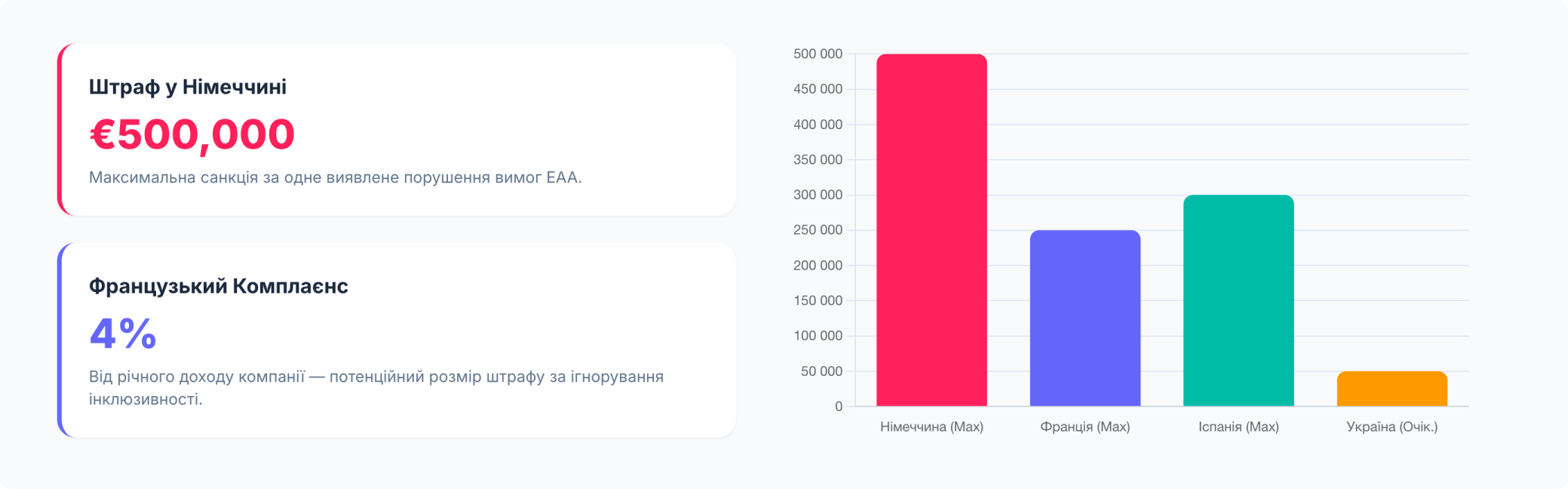
The EAA applies to companies selling goods or services to consumers in the EU, regardless of their country of registration. Fines vary from country to country: from €100,000 in Germany to €1 million in Spain for the most severe violations. There is an important exception: micro-enterprises (fewer than 10 employees, annual turnover under €2 million) do not fall under the law, whereas mid-sized businesses operating with the EU fully do.
While there is no direct law in Ukraine yet, government websites are already required to comply with the DSTU EN 301 549 standard — and Diia, Diia.Barrier-Free, and the updated website of the Ministry of Digital Transformation demonstrate what this looks like in practice.
The market businesses fail to see
This is not just about people with disabilities, although their combined purchasing power alongside their families is estimated at $13 trillion. Poor accessibility equally hinders an elderly person struggling with small fonts, parents holding a baby who cannot use a mouse, and anyone reading a website on a phone under bright sunlight.
According to SEMrush data (analyzing over 10,000 websites), sites complying with accessibility standards show noticeably higher organic traffic and rank better for key keywords — though this is one factor among many. According to the annual WebAIM report, nearly 96% of the world's top websites still have noticeable accessibility errors — giving an edge to those who fix them ahead of competitors.
What can be fixed without a developer
In recent projects, we consciously advised clients against manipulative pop-ups in favor of high contrast, large clickable elements, and logical navigation — and each time we saw the same result: users get confused less, and bounce rates consistently decrease without aggressive marketing tactics.
A few habits that can be fixed at the content level:
One trick to avoid is an "accessibility widget" promising compliance with a single line of code. The US Federal Trade Commission fined one of the largest providers of such solutions $1 million for deceptive claims, and the European Commission explicitly recognizes such "quick fixes" as non-compliant with the EAA.

How to verify that it actually works
Free extensions like WAVE or built-in Chrome Lighthouse are a good starting point: they quickly highlight missing alt texts or contrast issues. However, studies consistently show that automated tools catch only 30–40% of real accessibility barriers.
The most accurate insights in our practice always come from a simple test: turn off your mouse and try to complete an order or fill out a form using only your keyboard — Tab and Enter. Where focus gets lost or stuck is exactly where the barriers lie that no automated scanner can detect.
Conclusion
Accessibility is not a separate project that can be deferred for later. Contrast, intuitive navigation, and clear interface elements are established at the web design stage, rather than added on top of a finished layout post-factum. That is why it is a natural part of website design and redesign at MAS Agency, rather than a checkbox to tick right before launch.
Sources: The analysis is based on European Commission data on the European Accessibility Act (EAA) and its implementation practices in Germany, France, and Spain; UNDP and Ministry of Digital Transformation of Ukraine reports on government website accessibility (2025–2026); SEMrush research on the impact of WCAG compliance on organic traffic; the annual WebAIM Million report; US Federal Trade Commission and European Commission materials on the limitations of automated accessibility widgets.