Not Just Bringing Photos to Life, But Creating a Character: How We Made an AI Birthday Animation Film



A client from France found Mas Agency through a ChatGPT query: who in Ukraine can make such a custom animated story about a person's life. Less than a month later, on his birthday, her husband watched the finished film three times in a row and called it the best gift of his life. Between these events lies a story with twists, one deleted scene, and the answer to why "three pictures in Nano Banana and a video prompt from ChatGPT" do not make a film.
The Meeting It All Began With
A birthday biography film. The hero was born in Nantes, played rugby and worked as a journalist in his youth, and later founded a yacht charter company that grew from six boats into a global network. The client brought her own 15-scene outline with her own narrator script in French.
This requires clarification, because we usually write the script ourselves. We ask the client for a maximum of facts, events, and specifics, even if it's just a voice message. Then we dive into the story and draft the script. This is the most delicate part of the work, but not a barrier: a flair for this kind of writing is rare. In this case, the script was so accurate and close to the person that rewriting it would have been a mistake. We left it as it was, and a few inserts we added ourselves were agreed upon separately. In many ways, it is what made the subsequent feedback possible.
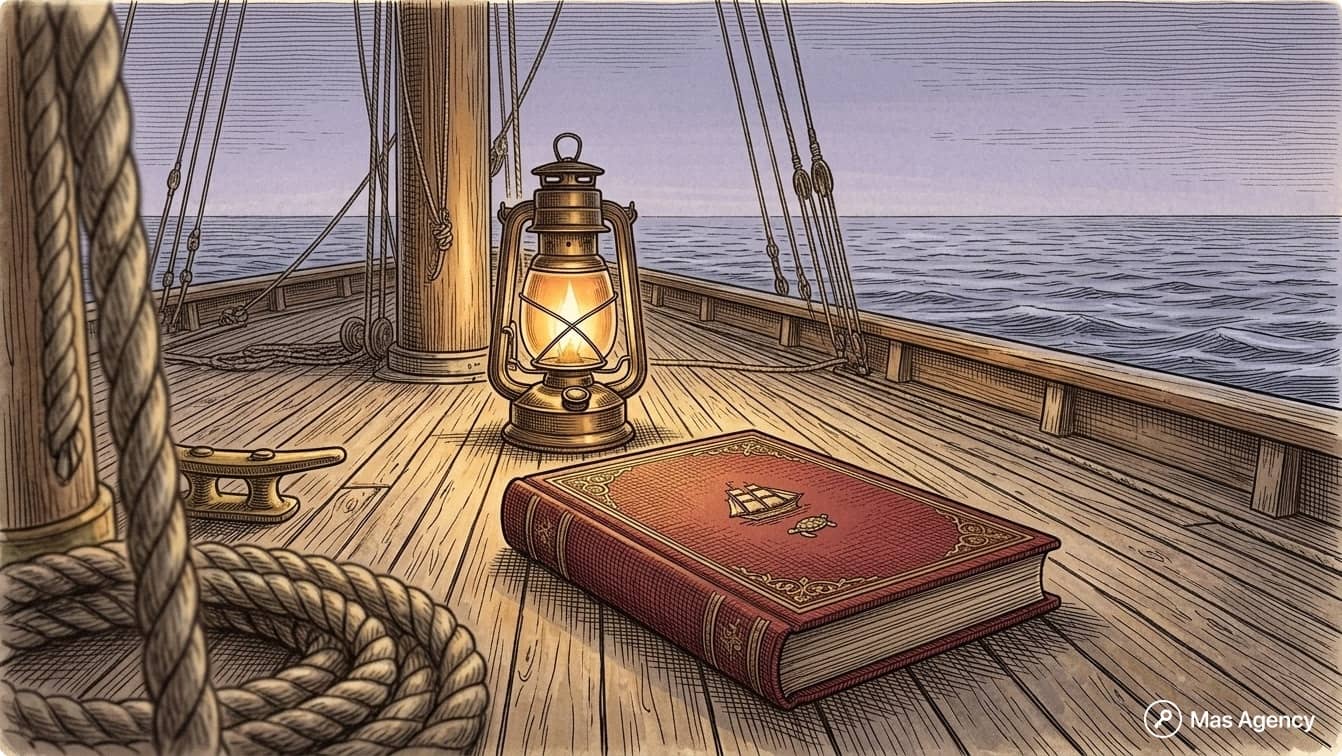
Everything else was born during a long online meeting between our team and the client. We immediately rejected 3D animation in the style of modern Disney — it feels alien to a hero from Jules Verne's hometown. We proposed an engraving style with light watercolor, just like in old illustrated editions of Verne. This style maintains recognition through characteristic details rather than photorealism, and forgives portrait inaccuracies, which are inevitable when there are few photos. That same meeting sparked the idea of presenting the entire film as a living, opening book.
Why It Is Actually Difficult
There is a common misconception that the difficulty of a personal film lies in making the person recognize themselves. That is not true. Almost any service can bring a real photograph to life today, and the result usually causes genuine surprise. The real difficulty begins where you need to create a character based on a photo. And often it is a poor-quality photo: a gray blur with a slightly fuzzy face on a group photo from forty years ago, and that's him. Yet this character must live in an animation, move, look, react, and remain precisely that person.
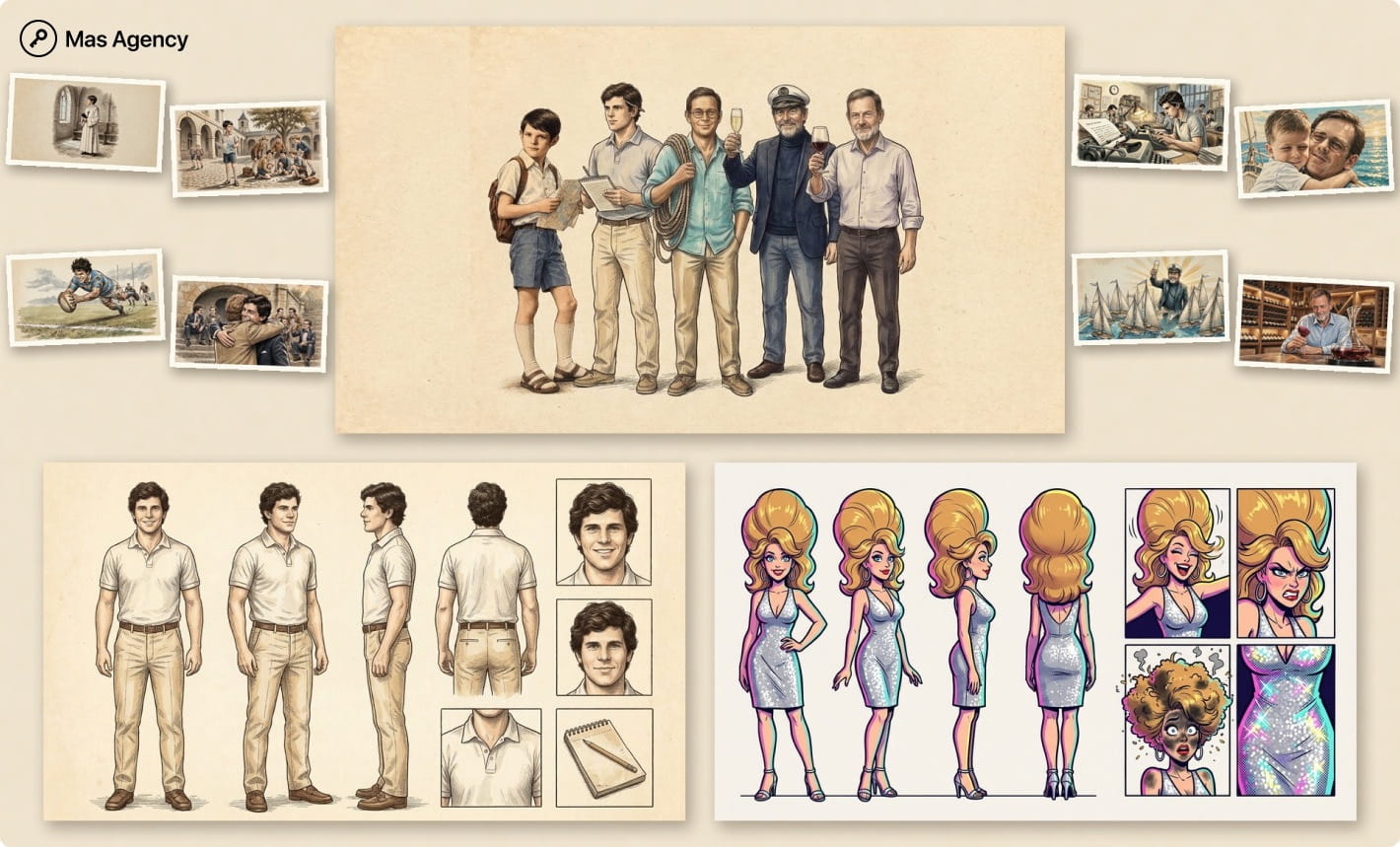
In our case, the task was multiplied by five. The hero appears as an infant, a ten-year-old boy, a rugby player and college student in his twenties, a company founder at forty, and his present-day self. Each age is essentially a new character who must look like themselves in the photos of that period, remain consistent within a scene, and pass the baton to their next self in the same style. Next to him are his youth friends, whom the client also wanted to see recognizable, while we only had one or two group photos from those years and a few modern ones. A typical situation: today the person is slender with a noticeable bald spot, but in that period he has to be a curly-haired, chubby guy. And not an abstract guy, but specifically the one recognized by people who saw him back then. We had never seen him back then and had to build his image from a verbal description. Only those who have tried to repeat this, rather than just accidentally getting a lucky picture, know how hard it is.
What we do about it. First, we sort the photos by periods and choose a single face source for each, because mixing snapshots of a person at 25 and 60 results in a third, completely different person. For each period, we create a character reference card in the film's style. All characters and cards are selected and strictly approved by the client before any further work continues. Because an otherwise beautiful character might have a detail that clashes with reality or the hero's self-image: an inappropriate button, waistline proportions, or relative height to other characters. Therefore, manual selection applies not only to cards, but to every single detail of clothing on them.
Why a Slideshow Is Dead
A sequence of even very successful generated frames set to music produces a dead video sequence. To make it a film, dramaturgy must be breathed into the plot, and it must fit the atmosphere and real events without stealing focus.
We start with voiceover and timings simultaneously. The voiceover is written with an understanding of how long each scene will last, and the scene's duration stems from what needs to happen in it. We didn't set a rigid runtime limit. The film had to be concise, with each chapter self-contained and fully developed. The fact that the birthday person watched the film three times is the main proof for me that we struck the right balance: he didn't just skip back to catch a frame, he went through the journey from start to finish.
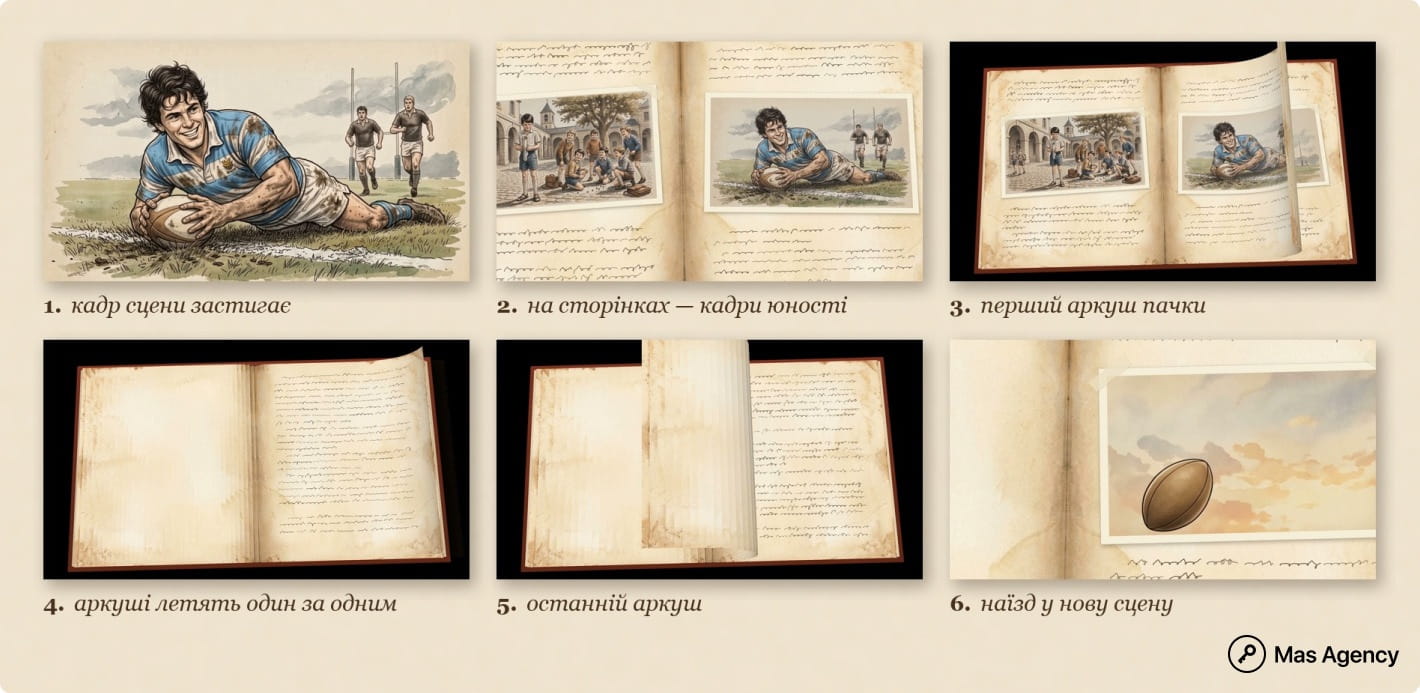
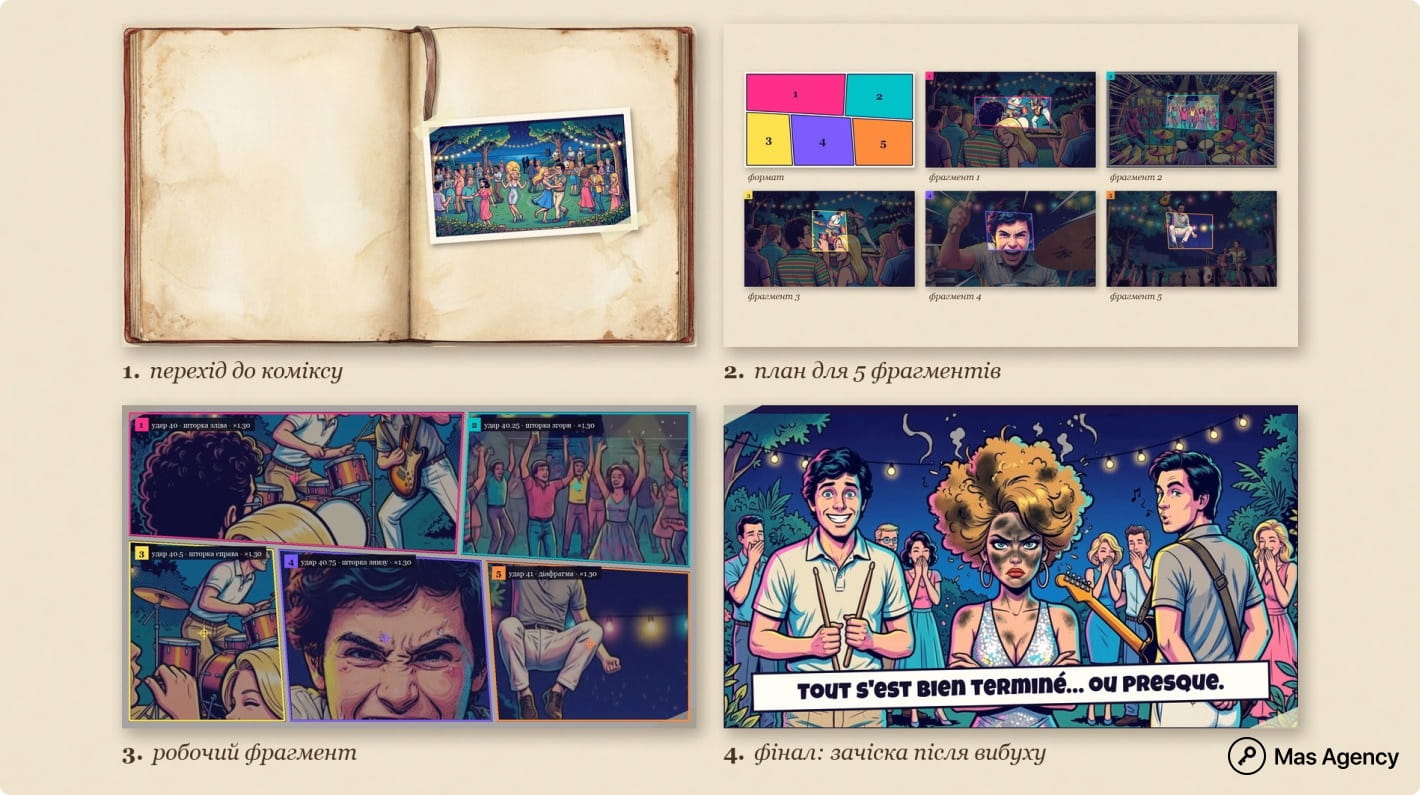
Inside the book, we embedded recurring techniques. Pages turn between chapters: a single page signifies the next event, while a riffle of rapid pages means years have passed. Objects are passed from scene to scene: a map, a ball, a typewriter page serve as transitions into the next chapter. The turtle from the company's first logo is hidden in every chapter as an Easter egg for those watching a second time. And a youth story that the hero's friends still retell at the table is styled as a magazine cutout. The camera plunges into it, and for forty seconds the calm engraving explodes into a neon comic strip. It is a high-energy release in the middle of a calm book, and this contrast makes it an event rather than just action.
The Chasm Between Image and Video
Generating an image in an engraving and watercolor style is relatively simple today. Maintaining that style in motion is hundreds of times harder. Generators pull engravings toward glossy 3D imagery, the line work "floats," and the scene stops looking like a book page. Add to this the character's behavior. We didn't have reference videos of the hero. Therefore, his manner of moving, smiling, holding a glass, or embracing loved ones had to be prompted in words — which is creative work, not technical.
A few rules we apply that actually work:
Images at the start — two options per request. One of the two is almost always usable, and choosing between two is faster than editing one.
Video is planned in short windows: one action and one camera movement with a clearly described end state. The reference frame is taken before the action, not at its peak. Falling with a ball is generated from the frame where the young man is still running, while the fall itself is described in text; otherwise, the model draws a static image that jitters.
Keep a balance between references and freedom. Focus video generation on characters and details that carry over from scene to scene. Anything that appears in a frame only once is better described in text, allowing the model to construct the frame itself. A compliment is due here to Seedance 2.5: it often handles this freedom better than rigid setups whose geometry it might misread. But this applies only to the most modern models. With simpler ones, it's the opposite: a reference frame and strict frame-to-frame guidance.
Task a modern image generator humanly, like a director instructing actors: who, where, what is happening, and why. Not long ago, you had to spell out every crumb, and whatever wasn't described didn't exist in the frame. Today, GPT Image 2.5 has become my ideal tool for frames, and version 2.6 came out just as we were finishing. It translates described situations and emotions into its internal language sometimes better than a massive technical prompt. Technical details are left solely for frame geometry: what is on the left, what is on the right, where the camera looks. This advice is tailored to a specific tool; Nano Banana has different rules.
Honesty About the Lost Scene
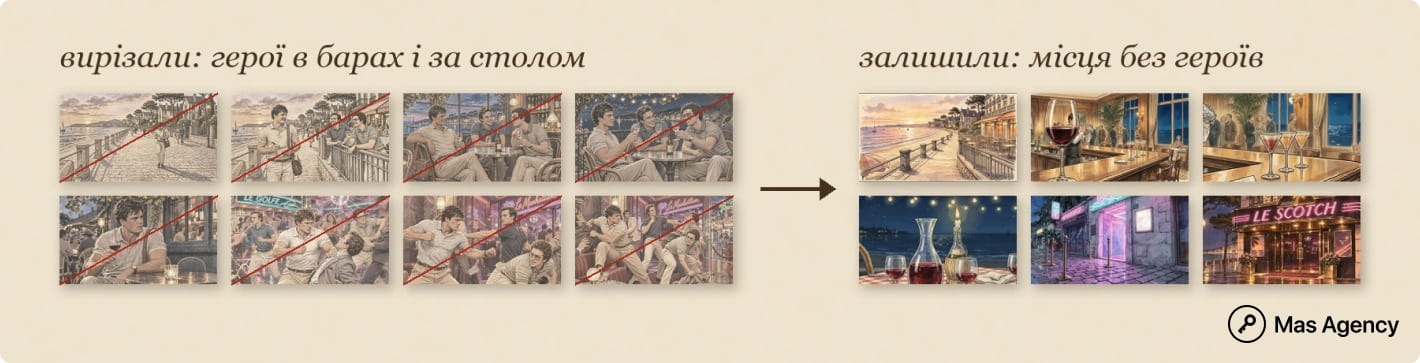
Now about failure. The hero's friends in their youth were quite the pranksters, and we wanted to show their whole routine in the film: meeting, hanging out, relaxing, up to action-packed brawls. We planned it, tried hard, created reference frames and scenes from character cards, but the video stubbornly turned out looking unlike them. As soon as movement started, gestures became generic and foreign, and those exact tiny nuances that made the characters "them" dissolved in motion. The client's feedback was unequivocal: they don't look like themselves, there's no emotional connection.
Resemblance in a still image doesn't guarantee resemblance in motion, and that must be tested before anything else. So we made the hard decision to cut the entire scene — which was cool on its own, but diverted attention to the fact that "those weren't the characters." Instead, we replaced it with an empty embankment at sunset, glasses on a bar counter, empty chairs in a restaurant, a string of club signs, and the narrator's voice recalling those evenings. If facial likeness fails, it's better to show landmark locations and objects than a stranger bearing a friend's name.
Editing: Debunking the "One-Button" Myth
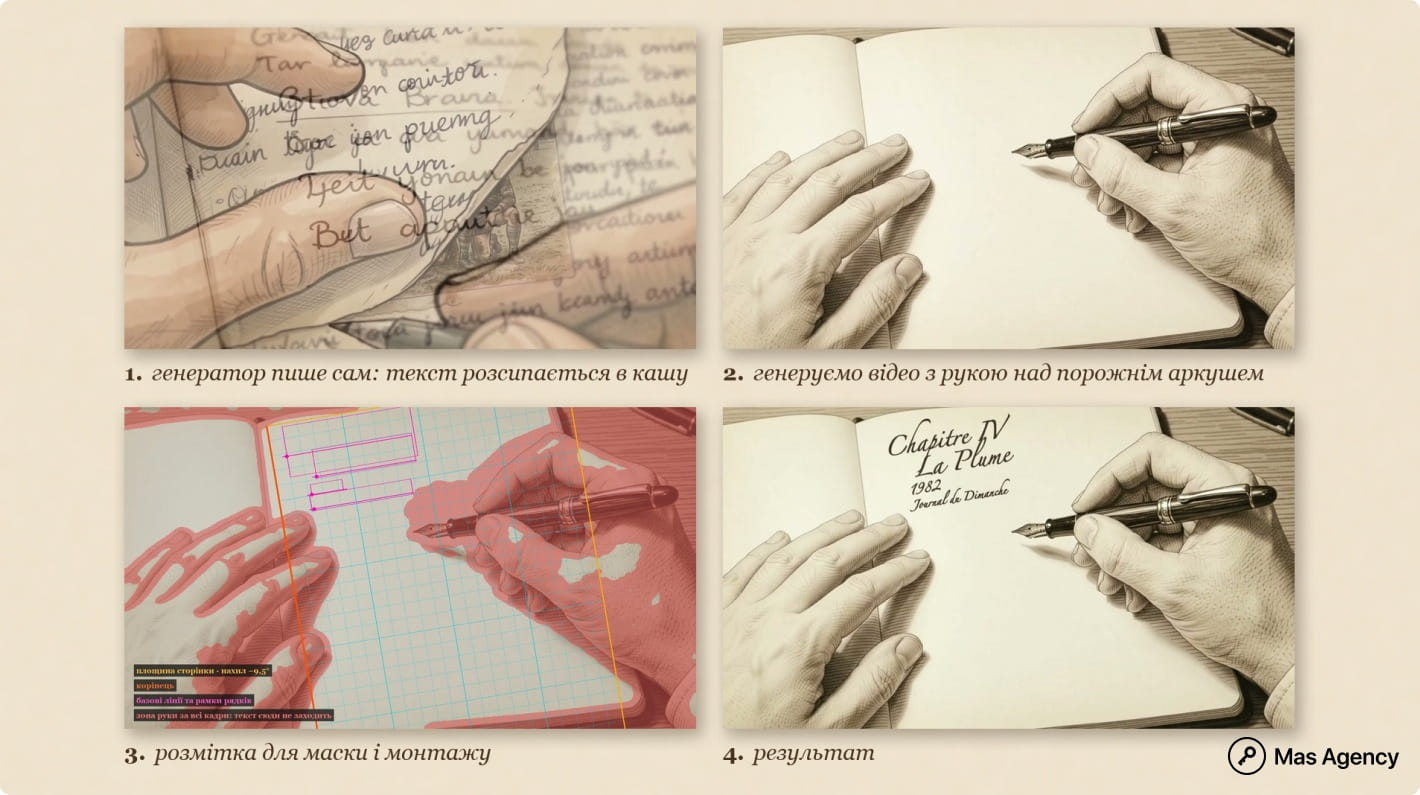
Video generators share a common flaw: text. Image generators have learned to write letters more or less decently; video generators haven't. Any piece of paper, newspaper, or notepad in a frame comes out as gibberish. We account for this during the planning stage: we generate a blank sheet and a hand, then add the required text during editing, skewing it to match the paper's plane and angle. If a character is writing something in a frame, it's better to show them from the side so the viewer doesn't see what is actually written. It's a simple trick that yields a clean frame instead of retouching, but it requires professional editing.
For the same reason, we never leave elements that must be precise and consistent throughout the film to the generator: titles, chapter headings, map routes, page turns, and so on. A route line we initially entrusted to the video model sprawled across the water like restrictive tape, and we had to redraw it. The comic strip was assembled as a separate system: each panel on screen lives its own life with its own camera and footage, while stickers, flashes, and split screens are locked to musical beats.
And let's be honest about artifacts. Minor generation flaws exist in the film; that's the reality of these tools. Our goal was different: to ensure no minor detail distracted, annoyed, or broke the rising emotion during viewing. Such spots were cut out, retouched, or remade. The rest remained, and the viewer doesn't notice it.
Music as a Character in the Film
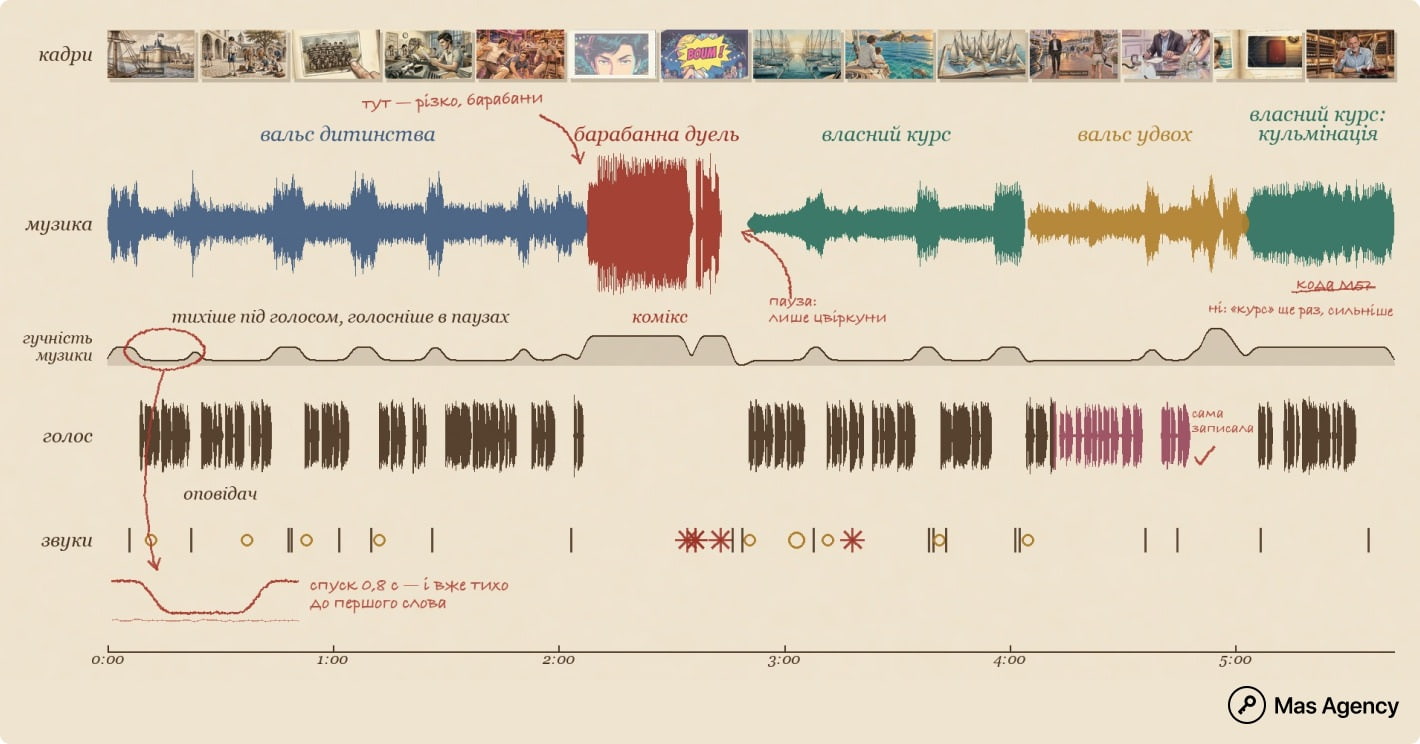
We agreed with the client on the soundtrack right at the beginning: no music that could trigger copyright blocks if the film is ever shared publicly. Therefore, tracks were created individually, tailored to the film's atmosphere and the birthday person's tastes: a waltz for childhood, high energy for the comic, a "custom course" theme for the second half, and a final waltz for the wedding. Sound sets the mood just as powerfully as visuals, sometimes doing half the job.
Music in the film is not background noise, but a second layer of dramaturgy: its internal transitions must align with the emotional turns of the story, so that when the film quiets down, the track does too, and when it builds, they build together. There is no universal rule here; every match is found individually. Sometimes we extend a frame so the music can catch up to an event, other times we shift the track so its accent lands on movement within the frame.
Regarding volume. Today, many people normalize music using automated tools, leaving the track to fit standard norms automatically. The main danger of such normalization is distortion: where a track is supposed to fade out, automation boosts it, noticeably spoiling the whole picture. Established audio standards have long existed regarding how much to duck music under a voiceover so it doesn't drown out or compete with words. We keep the track at a single level throughout the film, with its own natural quiet and loud passages. The only thing that modulates the music is a smooth ducking under the voiceover that starts before the first word and lifts after the last. No abrupt steps.
The Test of Truth
There's another thing people rarely write about. Generation occasionally produces stunning imagery: a flawless transition, a frame you'd love to put on the cover. And yet it doesn't make it into the film because a detail appeared that never existed in real life, an event was distorted, or the hero looked just slightly off. For a fictional story, such generation would be a goldmine. In a true story, it has to be thrown out, and every time it's a small internal struggle because your hand hesitates. But it is precisely from such rejections that a film built on genuine trust is formed.
The paradox is that an outside viewer won't see this labor. To them, it's just a picture, and they will judge it by picture standards — someone might even say it could have been drawn more beautifully. But the person for whom the film is intended sees details in the frame that no one else knows: their own courtyard, their own gesture, their friend. The primary value of such a film is invisible from the outside, and that is its nature, not a flaw. Therefore, we maintain two standards simultaneously: truth for the hero and aesthetics for everyone sitting nearby.
What We Advise Based on Experience
Everything below is something we consistently apply in practice. This project merely confirmed that it works.
1 The story is brought by someone who knows the hero, while we search for the form together. The client is not a spectator, but a co-creator: their remarks about a school the hero disliked or how an event happened in a garden rather than a club are worth more than any new model. Bring "too many" facts: we'll filter out the excess, but we won't invent what's missing.
2 Accuracy beats richness. Only what firmly lives in the hero's memory belongs in the frame. Names, figures, and dates wrapped in doubt add nothing to the film, but can ruin the evening.
3 Test likeness in motion, not just in stills. One short character video test before mass generation saves a week of work.
4 Generate imagery, but build cohesion by hand. Titles, transitions, routes — anything that must remain identical throughout the film belongs in editing, not in the generator.
5 Rhythm matters more than runtime. Each chapter is self-contained; pauses exist only where something is happening in the frame, with no empty air for the sake of air.
6 Remember who the primary viewer is. Such films are created first and foremost for specific individuals, and every decision — from a heart woven out of two ropes at a wedding to silence before the comic book explosion — is made for them.
Conclusion
The screening didn't take place at home or at a party, but on a fairly large screen. The hero watched the film three times in a row and called it the best gift of his life. His wife wrote to us that she had never seen him so emotional, and alongside them, people who didn't even know the hero personally watched it and caught the emotional wave. That is the answer to what makes such a film powerful. Not the imagery in itself, but the fact that every single detail is tied to a specific human being.
If you are considering such a gift for someone close to you, formats and examples can be found on the MAS Agency AI Personal Movies and Greetings page. You bring the story, and we already know how to turn it into a film.