Fundraising in Ukraine: Two Mechanics That Raised Millions



Why announcing a fundraiser is no longer enough
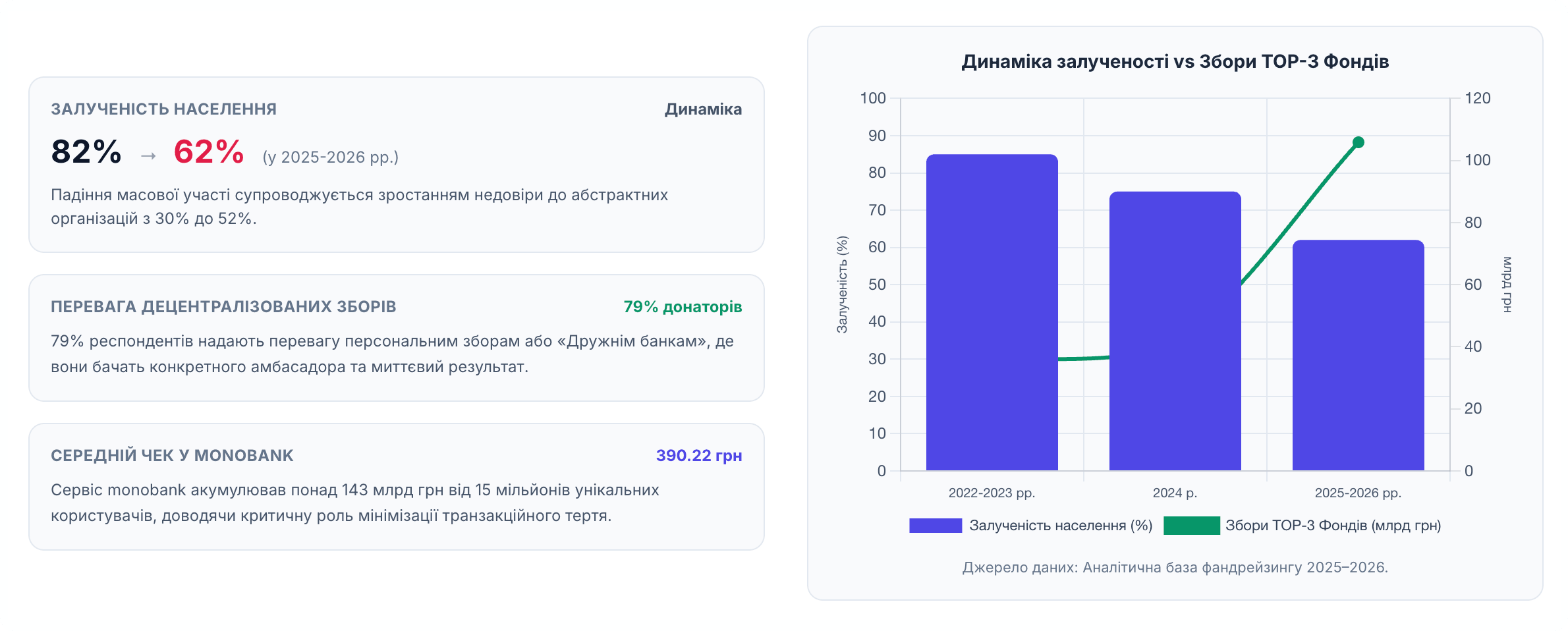
Ukrainians have not stopped giving, but they have stopped giving reflexively. Research by the Zagoriy Foundation shows participation in charitable giving falling from 80–85% in 2023–2024 to 62% in 2025, while distrust of foundations and volunteers as a barrier to donating has climbed from 30% at the start of the full-scale invasion to 52%.
The money, meanwhile, has grown. According to Opendatabot, Ukraine's three largest funds raised 105.87 billion hryvnias in 2025 alone, thirty-seven per cent more than in the previous three years combined. Peer-to-peer giving tells the opposite story: donations through monobank jars peaked back in 2024, having moved 143 billion hryvnias in total from more than fifteen million people, with an average gift of about 390 hryvnias.
For international donors evaluating Ukrainian partners, this matters. The market has consolidated. People give less often, in larger amounts, and only to organisations they recognise. The appeal itself is no longer the news event — the campaign has to be.
Mechanic one: a collaboration with a public figure
In the summer of 2023, Razom for Ukraine and Ukrainian travel blogger Anton Ptushkin ran a United States campaign under the Razom Heroes programme, raising 200,000 dollars for ten mobile shower-and-laundry units for soldiers.
The interesting part is the choice of goal. As the fund explained, Ukrainian donors give readily toward drones and weapons, whereas American donors approach such appeals cautiously and prefer humanitarian causes. So the goal was framed in domestic, countable terms: not "support for the army" but ten specific units.
The format mattered just as much. This was not a post with bank details. The campaign rested on two charity gatherings in New York that drew more than three hundred attendees, plus an online auction of commemorative lots. A campaign like that has a date, a venue, a programme and an ending, which is precisely what newsrooms need in order to cover it.
Our team produced the full visual identity for the gathering and the auction, and handled the Ukrainian side of the communication strategy: announcements, press and post-event releases, and outreach to Ukrainian media. The money was raised abroad, but the outcome still had to reach the audience at home. Details — in the news about the event.

Mechanic two: a systematic campaign against a hard deadline
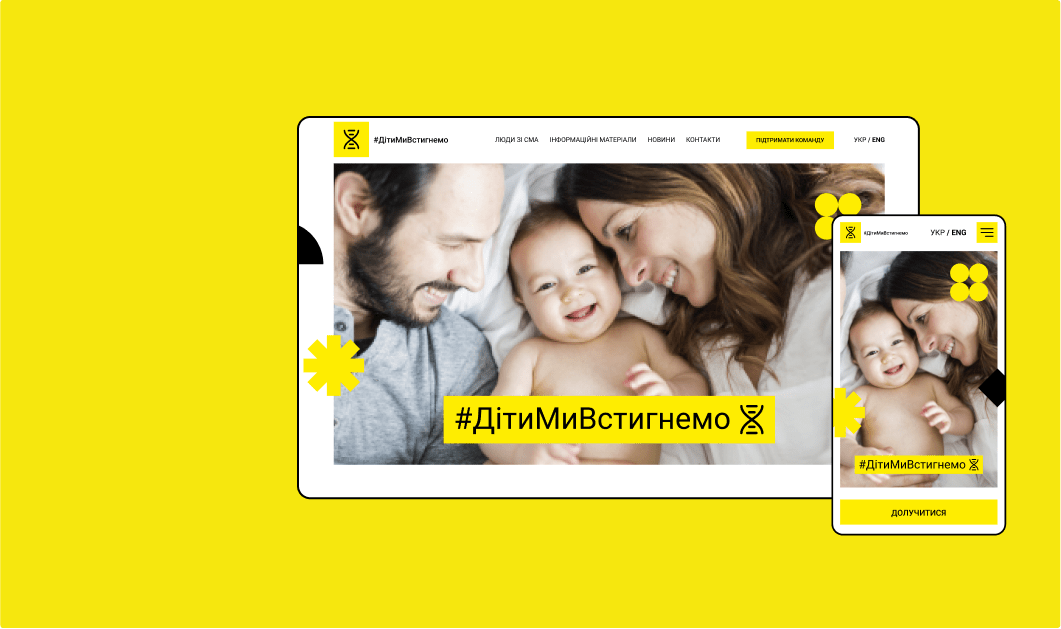
In the spring of 2021, a team that our agency joined raised two million dollars in eighty days for a Zolgensma treatment for a child, Dmytro Svichynskyi. The deadline was clinical rather than promotional: the injection had to be administered before the child turned six months old.
No single appeal survives that distance, because no audience holds attention for three months. The campaign was therefore built as a chain of news events. The father's opening post drew twenty-one thousand shares. Then came matching days, when a private philanthropist committed to double everything raised within twenty-four hours: on 18 March the campaign took in 3,010,730 hryvnias, and the doubling added six million to the accounts. A celebrity date auction brought in 520,200 hryvnias across forty-six lots. The core appeal was translated into thirteen languages for diaspora communities.
More instructive than the list of what worked is the list of what was abandoned. Paid social advertising delivered reach and engagement but did not move the total meaningfully, so it was dropped. Instead of a website whose development was dragging on, the team spent fifteen dollars and one hour on a Taplink page. Auctions run from the campaign page failed on logistics, so the model was rebuilt: the owner listed the item on their own profile and the team amplified it.
Trust deserves a separate note, because it is now the single largest barrier. The campaign was accused of being fraudulent within weeks. The response was documentary: scans of the diagnosis from Ukraine's national children's hospital and from a German laboratory, and a video statement from the child's physician, all pinned prominently. Full breakdown of campaign tools we once published as a separate article.
What the two campaigns share
Both had a goal a donor could verify mentally: ten units, or one injection with a known price and date. Both prepared evidence in advance rather than defending themselves afterwards. Both had a hard deadline, which is what earned them the right to come back to the audience repeatedly.
And in both, matching was the decisive lever. In 2021 it was a private arrangement with one philanthropist; in 2024 the logistics company Nova Poshta doubled every donation to an air-defence appeal. Western fundraising calls this corporate matching gifts and presents it as advanced corporate practice. Ukraine's sector arrived at the same mechanic earlier and from below, starting with a single private agreement.

Where a smaller organisation should start
Begin with legal hygiene. Funds arriving on a personal card are treated by the tax authority as taxable income, at eighteen per cent personal income tax plus a five per cent military levy. Entry into the state Volunteer Register removes this: the application is filed electronically through the taxpayer's e-cabinet, and the extract is issued on the day of inclusion. For international donors, a partner's registration status is a fast and reliable due-diligence signal.
Next, prioritise recurring donors over one-off gifts. M+R benchmarks put twelve-month retention of recurring donors at seventy-one per cent, against roughly a quarter for new one-time online donors.
Above all, both mechanics rest not on advertising budget but on the ability to give media and public figures a recurring reason to talk about the cause. That is continuous work with contacts, formats and news hooks, and it is work worth running systematically, together with the media and influencer collaboration practice at MAS Agency.
Sources: this analysis draws on the Zagoriy Foundation charitable giving study for 2025, Opendatabot data on donations to Ukrainian funds, monobank fundraising statistics, Razom for Ukraine publications on the Ptushkin campaign, M+R Benchmarks 2026 donor retention data, and guidance from Ukraine's State Tax Service on the Volunteer Register.