What a Voter Sees When They Google a Politician's Name




A voter, journalist, or potential partner forms an opinion about a politician before the first click. Suggestions in the search bar, a photo with a short description on the side, and the top ten headlines are all it takes. The first page of Google is a resume that the politician mostly didn't write. Almost every section of it can be legally influenced, and it is precisely the "quick fixes" that cause the most damage here.
What makes up name-based search results
The first thing a person sees are search autocomplete suggestions that drop down below the search bar as they type. Google builds them from real queries: if "[name] scandal" appears, it means people have already searched for it. Suggestions that read as a stance "for" or "against" a politician or party are prohibited by Google's rules, while a neutral "[name] court" does not fall under the ban. Check them in incognito mode, because in their own browser, a politician sees search results tailored to their personal search history.
On the right—or as the first screen on a mobile device—stands the knowledge panel: photo, title, a few lines of description. Google compiles it automatically, but the person concerned can claim ownership of the panel and suggest edits. Check whether the photo and job title in it are up to date.
Next come social networks. Since July 10, 2025, Instagram has allowed Google and Bing to index public posts and Reels from professional accounts published since 2020. The caption under a post now works for search, and an old archive of a professional account may unexpectedly end up in search results. Indexing can be turned off in privacy settings. We broke down how to build a social media presence between elections separately.
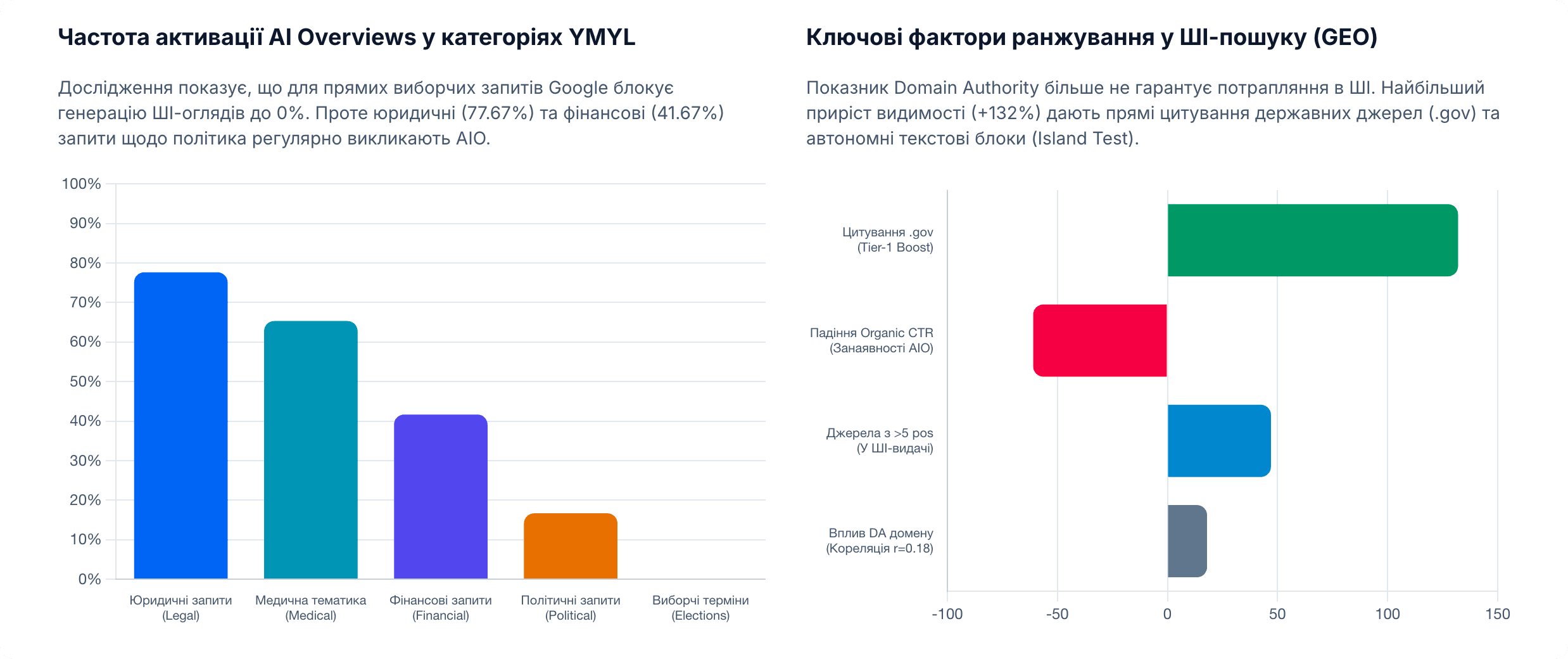
The final layer is AI Overviews—generated answers displayed above organic results. In the summer of 2026, AlgorithmWatch examined 4,480 queries about elections in three German states. For election-related queries, an overview appeared in 39% of cases, for non-political queries in 65%, and for queries about specific politicians in 40–50%. Almost half of the links in overviews led to ten domains, most frequently YouTube. So a politician's video channel also serves as a source for the machine writing a profile on them.
What to do with negative content in the top results
The fastest tool is the right to reply under Article 43 of the Law "On Media". The application is submitted to the editorial team within 20 days of publication, and online media must review it without delay, within 5 days at the latest. The article won't disappear from the top results, but the reader will see the politician's position alongside it.
Court proceedings are slower and narrower in scope. Facts can be refuted, but value judgments are not subject to refutation—this is explicitly stated in Article 30 of the Law "On Information". The court cannot compel a media outlet to apologize either, as confirmed by the Supreme Court. Sharp criticism is addressed with arguments.
A separate issue is fake copyright infringement complaints (DMCA). The text of a critical article is copied to a fake website backdated to an earlier timestamp, and a complaint is filed with Google claiming the media outlet stole the "original". Google forwards copies of complaints to the public database Lumen. In 2022, a Lumen researcher analyzed nearly 34,000 such complaints from 2019–2022: 28% were sent from Ukraine and Russia, and 99.2% failed. The article remains in search results, while the record in the database becomes a ready-made news story for journalists.
Mass publication of native advertising/sponsored articles ("dzhyosa") on authoritative sites won't save you either. Since 2024, Google has penalized site reputation abuse: third-party content published solely to capitalize on someone else's domain authority loses rankings. In August 2026, manual actions for this stopped applying to searches from the European Economic Area, but Ukraine is not part of it.
How long it takes to change the picture
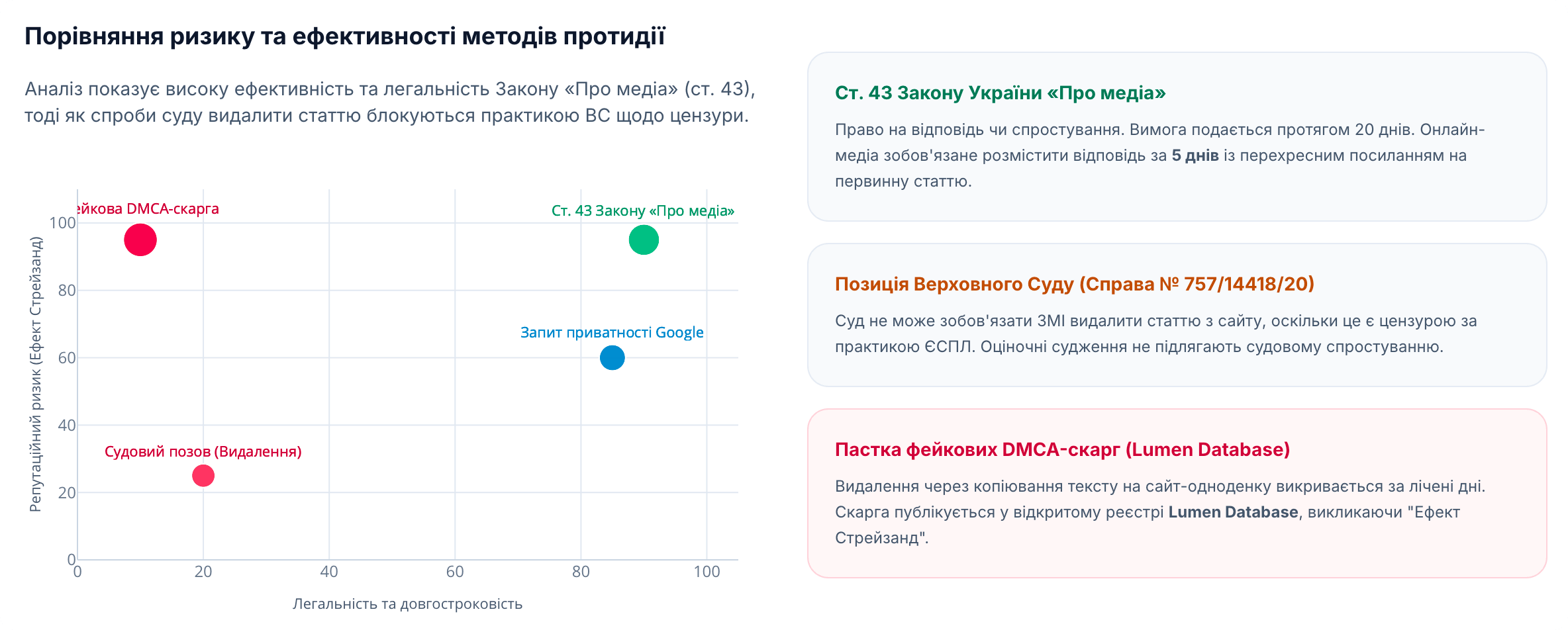
A media response under Article 43 takes days. A corrected knowledge panel or indexed Instagram posts take weeks. Displacing a strong publication from the first page takes months of work, and search suggestions change the slowest because they follow what people type into the search bar. When a contractor promises a "clean top 10 in a week," ask them exactly how.
Prevention instead of firefighting
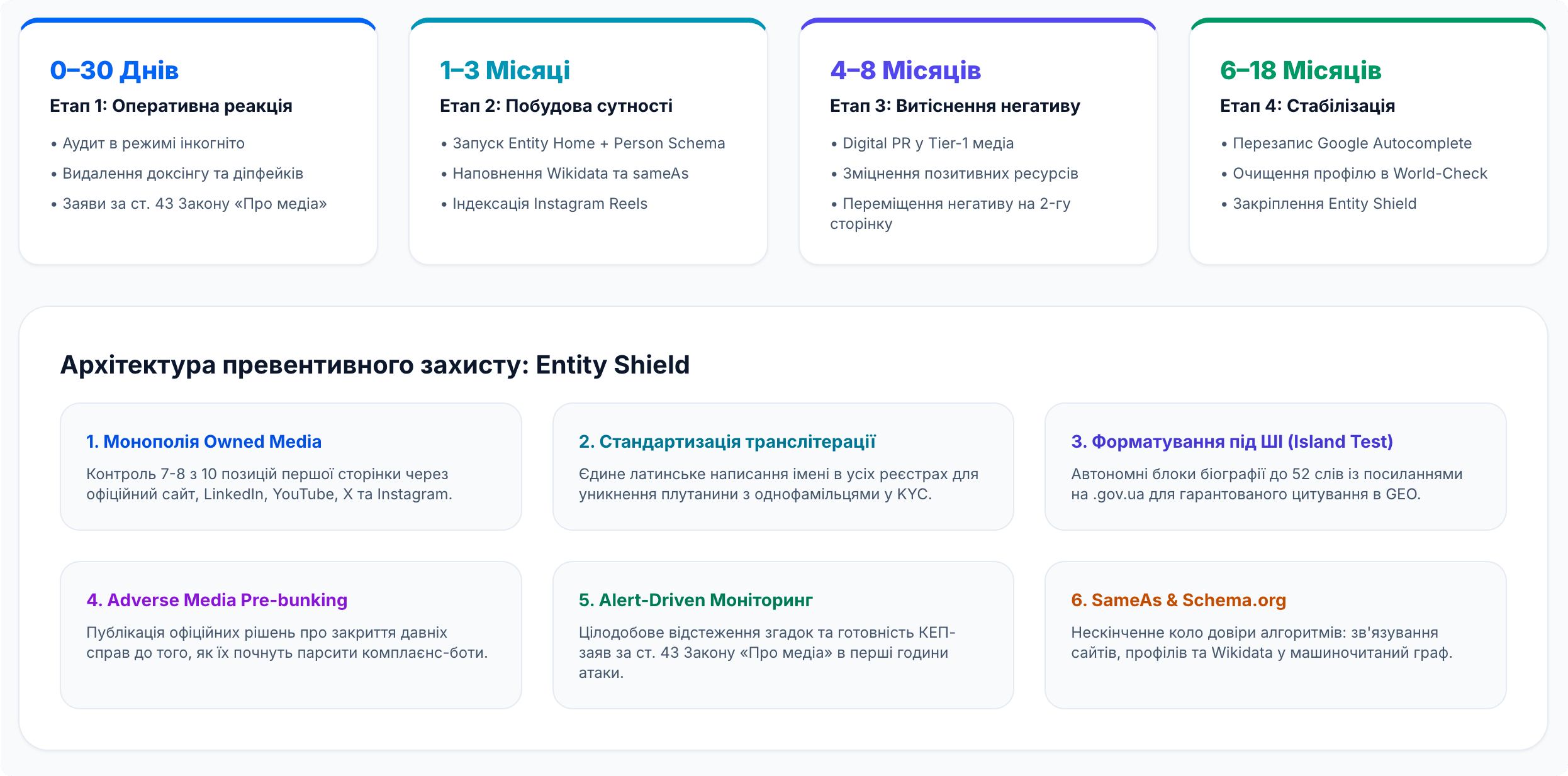
In political projects, we see the same thing time and again: search results that have an anchor center are significantly harder to attack. That anchor is a personal website featuring a biography, official position, reports, and contact info, linked to by all official profiles. Journalists draw official statements from it, while Google and AI models verify facts against it. The rest comes from consistency: swift response to news agendas, ongoing coverage of activities, video reports, and a timeline measured in years rather than a few months of a campaign. We also discuss this in digital communications trainings, including those for the Sumy City Council and representatives of public organizations.
It is best to organize the first page before it comes under close scrutiny. When the top ten positions are occupied by your website, verified profiles, and substantive publications—and autocomplete suggestions along with the knowledge panel are monitored by a team—a single smear campaign won't turn the picture upside down. This is the core principle behind MAS Agency's political PR and reputation management service: ensuring that voters find what is truly worth reading on the first page.
Sources: Analysis is based on Google documentation on autocomplete policies and knowledge panel verification, Instagram Help Center on indexing public posts, AlgorithmWatch study on Google AI Overviews in the 2026 German elections, Article 43 of the Law of Ukraine "On Media" as analyzed by ZMINA, Article 30 of the Law of Ukraine "On Information" and Supreme Court practice, research from the Lumen database (Berkman Klein Center, Harvard) on fraudulent DMCA complaints, and the Google Search Central blog on the site reputation abuse policy (August 2026).